

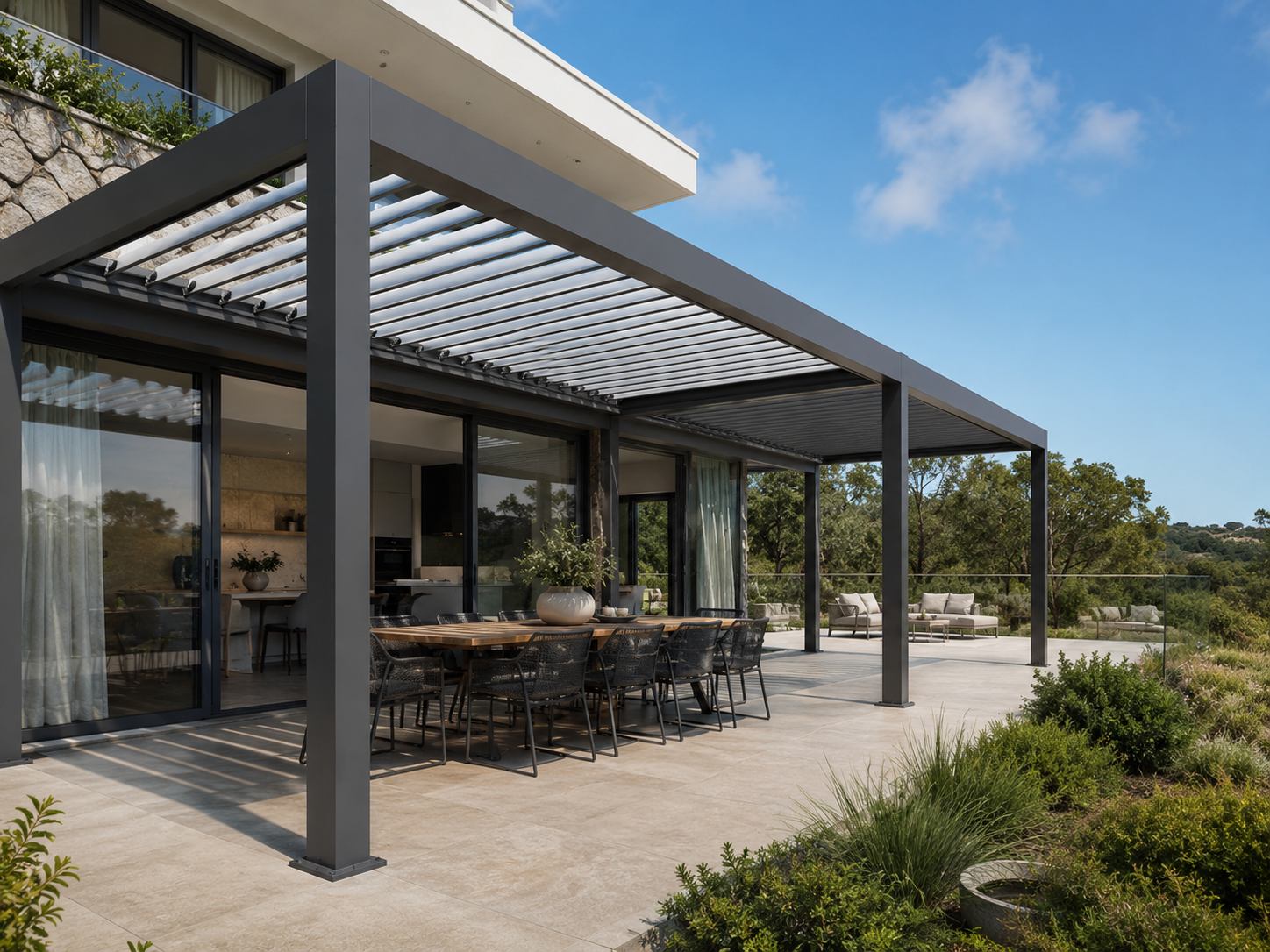
Power for a motorised pergola should be planned before the frame is installed and, ideally, before paving, wall finishes or deck access are closed. The practical questions are straightforward: which parts of the chosen configuration need power, where the supply can approach the pergola, who will complete the final electrical work and whether lighting or other powered options are being included from the start.
Homeowners do not need to design the wiring themselves. They do need to confirm the pergola model, control type, lighting choice and proposed position early enough for Everpergo, the installer and a suitably licensed local electrician to coordinate the project without avoidable rework.
Electrical note: This guide explains project planning, not electrical installation. The final supply, cable route, protection, connection method and compliance requirements must be assessed for the selected product and site by the appropriate licensed professional.

What needs power in a motorised pergola?
The louvre motor is the obvious powered component, but it is not always the only one. Integrated LED lighting and the supplied control equipment can change where cables and components need to sit. A project with powered roof movement and lighting needs more coordination than a manual roof with no electrical accessories.
The order confirmation matters more than the model name alone. Two pergolas from the same range may be ordered with different control or lighting options. Before any electrical route is finalised, check the exact configuration being purchased and what is included in the package.
| Part of the setup | Planning question | What to confirm |
|---|---|---|
| Louvre operation | Is the selected roof manual or motorised? | The operation type shown on the final order, not an assumption based on the product image. |
| LED lighting | Is lighting included now, or might it be added later? | Whether the selected configuration includes lighting and how it is controlled. |
| Controller or receiver | Where can the supplied equipment remain accessible and protected? | The manufacturer’s placement requirements for the exact system supplied. |
| Future powered options | Would later additions require finished surfaces to be opened again? | Only plan for options that are realistically expected; unnecessary provision can add cost and complexity. |
A manual pergola does not need power for louvre movement, although lighting or other selected accessories may still create an electrical requirement. That distinction is useful when comparing configurations: choosing manual operation can remove the motor supply from the project, but it does not automatically mean the entire outdoor area is free of electrical work.
Practical answer: decide the roof operation and lighting package before the electrician is asked to plan a route. Otherwise, the electrical discussion begins without a confirmed load or component layout.
How the site changes the cable route
The neatest route is rarely decided from the pergola alone. It depends on the house, the proposed post locations and what has already been built around them. Wide site photographs are valuable because they show the relationship between the pergola area, the building, paving, deck access, gutters, downpipes, doors and existing outdoor services.
Wall-mounted pergolas
A pergola attached to the house may appear to offer the shortest power route, but the wall type and roof edge still need to be understood. Windows, doors, eaves, gutters and downpipes can limit where components or cables can be placed. Structural fixing and electrical routing should be discussed together so that one trade does not block the other.
The position of the kitchen, living room or existing outdoor lighting may help identify a practical direction, but a nearby wall point should not be treated as automatic approval to connect. The electrician still needs to assess the existing supply and the proposed work.
Freestanding pergolas
A freestanding structure may sit several metres from the house. The route then has to work around paving, landscaping, garden beds and the final post layout. If the patio is still being designed, early coordination gives the trades more options. If the area is already finished, the available route may be longer, more visible or more disruptive.
Post placement deserves attention because the structural plan determines where services can approach the pergola. Moving a post later may affect furniture clearance, footings, drainage and the proposed cable path. Settle the pergola footprint before treating the power route as final.
Decks and completed patios
A completed deck or paved area does not automatically rule out motorised louvres. It does mean that access must be understood before a clean route is promised. Useful questions include whether the underside of the deck is accessible, what sits below the proposed posts, whether tiles or pavers can be disturbed and reinstated, and how far the pergola is from a suitable supply point.
The same principle applies to recently rendered walls or landscaped gardens. Power can sometimes be added later, but “possible” and “simple” are not the same. Asking before finishes are complete usually protects both appearance and budget.
Drainage, moving parts and access
A louvred pergola also has moving roof components and an integrated drainage path. Electrical equipment should not be positioned by convenience alone. The supplier’s instructions, drainage direction, service access and the installer’s structural plan all need to be considered before locations are agreed.
When should power be planned?
The best time is after the preferred pergola configuration and location are known, but before construction details are locked in. Planning too early produces guesses. Planning after the slab, deck and wall finishes are complete can remove otherwise tidy options.
| Project stage | Decision to make | Common mistake to avoid |
|---|---|---|
| Before requesting a firm quote | Choose likely model, manual or motorised operation, lighting and layout. | Comparing prices without comparing the same configuration. |
| Before paving, decking or wall finishes | Identify a likely route and any access that should remain available. | Finishing the area before the trades have seen the plan. |
| Before pergola installation | Confirm post positions, component locations and responsibility boundaries. | Assuming the pergola installer automatically includes all electrical work. |
| At completion | Test operation, keep product and electrical documents, and understand basic care. | Losing the final configuration details needed for later support. |
This order also helps with budgeting. A product price can be compared separately from electrical work, site preparation and any work needed to create a suitable route. Without that separation, a low initial quote may appear complete even though important site costs have not been discussed.
Do not book the electrician only after the pergola has been assembled unless the installer and supplier have already confirmed that sequence. The correct order depends on the selected system and site, so the trades should agree on access and timing before installation day.
Who should confirm each part?
Many installation problems come from an unclear boundary rather than a difficult product. The supplier understands the product configuration. The pergola installer understands the frame, fixing sequence and site assembly. The electrician assesses the electrical work. The homeowner coordinates access, approvals and the choices that affect the finished outdoor area.
Before paying a deposit, ask for four answers in writing:
- What motor, control and lighting equipment is included with the selected configuration?
- What work is included in the pergola installation quote?
- Who arranges and pays for the licensed electrical work?
- What must be ready on site before the pergola installers arrive?
Everpergo or the product supplier should confirm the ordered model, operation type, included controls, lighting options, product instructions and applicable product warranty. Product advice should be based on the exact size and configuration, not a general description of the range.
The pergola installer should confirm the structure’s position, fixing approach, assembly sequence, access requirements and where product components are expected to sit. Installation workmanship and product warranty should not be treated as the same responsibility.
The licensed electrician should assess the available supply, proposed route, required electrical work and local compliance obligations. A product image, sales quote or nearby outdoor socket cannot replace that assessment.
The homeowner or project manager should provide accurate site information, approve the chosen options and make sure the trades are working from the same layout. One shared marked-up photo or plan is often more useful than several separate conversations.
How model choice affects power planning and cost
Everpergo’s current comparison information lists P180 and P180 Pro with manual or electric control options, while available sizes and configurations vary by model. That makes the selected order—not merely the family name—the correct starting point for electrical planning.
For a compact patio that will rarely change roof angle, a manual option may avoid the need to power the louvre motor. For a larger dining or lounge area where the roof will be adjusted throughout the day, motorised operation may justify the additional planning. The decision should follow actual use, reach and site access rather than a belief that electric is always better.

Separate the product price from the project cost
The powered configuration can affect the product price, but the site can affect the final cost just as much. Electrical work, access, the distance and difficulty of the route, finished surfaces, lighting choices and coordination with other trades may sit outside the pergola price. Ask each quote to state what is included and excluded.
Avoid requesting a universal electrical allowance from product photos alone. A simple wall-mounted project and a freestanding pergola across a finished garden may use the same roof configuration but create very different site work.
Check the motor and structure warranties separately
Everpergo currently states a 10-year warranty for the main aluminium structure and a 2-year warranty for motorised systems. Those periods cover different parts of the purchase, so review the current terms for the exact model and keep the final order details with the warranty documents.
For long-term support, record the model, size, operation type, lighting choice, controller information and installer details. Everpergo’s maintenance guidance also advises keeping motorised components free from dust and debris and checking the pergola periodically. Routine care does not replace service work, but it helps keep the moving system clear.
Before purchase, also ask what happens during a power interruption and whether the supplied system has any model-specific emergency or manual operating procedure. Do not assume every motorised pergola behaves the same way.
What to prepare before requesting a quote
A useful enquiry shows the whole installation area and explains how the pergola will be used. One close-up of the paving is not enough. The following information helps the product team narrow the configuration and gives the installer and electrician a more realistic starting point.
- Dimensions: patio width, projection, available height and any restricted clearance.
- Wide site photos: one view from the garden toward the house and one from the house toward the proposed pergola.
- Building details: walls, eaves, gutters, downpipes, doors, windows and nearby roof edges.
- Ground or deck: concrete slab, tiles, pavers, timber deck, composite deck or unfinished landscaping.
- Preferred layout: wall-mounted or freestanding, including any reason one layout is preferred.
- Chosen functions: manual or motorised louvres, LED lighting and any likely future powered additions.
- Existing services: visible outdoor power points or lighting near the area, shown only as site information for the electrician to assess.
- Project timing: whether paving, decking, rendering or landscaping is still open or already finished.
- Location and access: postcode, side access, stairs, narrow gates or other restrictions relevant to delivery and installation.
Ask for a written summary of the proposed configuration after these details are reviewed. The summary should identify the model, size, colour, layout, operation type, lighting choice, included installation work and known exclusions. That document gives the electrician and installer a common reference.
The final electrical design still belongs to the licensed professional, but a complete product and site brief prevents that professional from having to work around missing decisions.
Confirm the configuration before the site is closed in
Send Everpergo the patio dimensions, wide site photos, surface type, preferred layout and intended lighting. The team can help narrow the pergola configuration before the installer and electrician finalise the site-specific work.
Contact Everpergo for configuration supportFrequently asked questions
Does every motorised pergola need electrical planning before installation?
Yes. Even where power is already available nearby, the selected motor, controls, lighting, component locations and connection method still need to be confirmed for the product and site. The complexity varies, but the planning step should not be skipped.
Can an existing outdoor power point be used?
Possibly, but its location alone does not answer the question. A suitably licensed electrician needs to assess the existing supply and the proposed connection for the selected pergola and local requirements.
Should LED lighting be selected before the pergola is installed?
Yes, when possible. Lighting can affect the cable and control plan. Deciding early is usually cleaner than trying to add wiring around finished paving, walls or deck work later.
Does the pergola installation quote include the final electrical connection?
Not necessarily. Ask the supplier and installer to state their inclusions, then confirm who arranges and pays for any fixed electrical work. The responsibility should be clear before installation day.
Can power be added after paving or decking is finished?
It may be possible, but the available routes can be more limited or visible. The site needs to be assessed before cost, appearance or disruption is promised. Planning earlier normally gives the trades more options.
What happens to the louvres during a power outage?
The answer depends on the motor and control system supplied with the selected configuration. Before ordering, ask whether there is a model-specific emergency procedure or manual operating method. Do not assume that every motorised system includes the same feature.
Share:
Louvered Roof System vs Patio Roof: Which Is Better for All-Season Use?
Motorised Pergola Maintenance: Motor, Louvre and Drainage Checks