

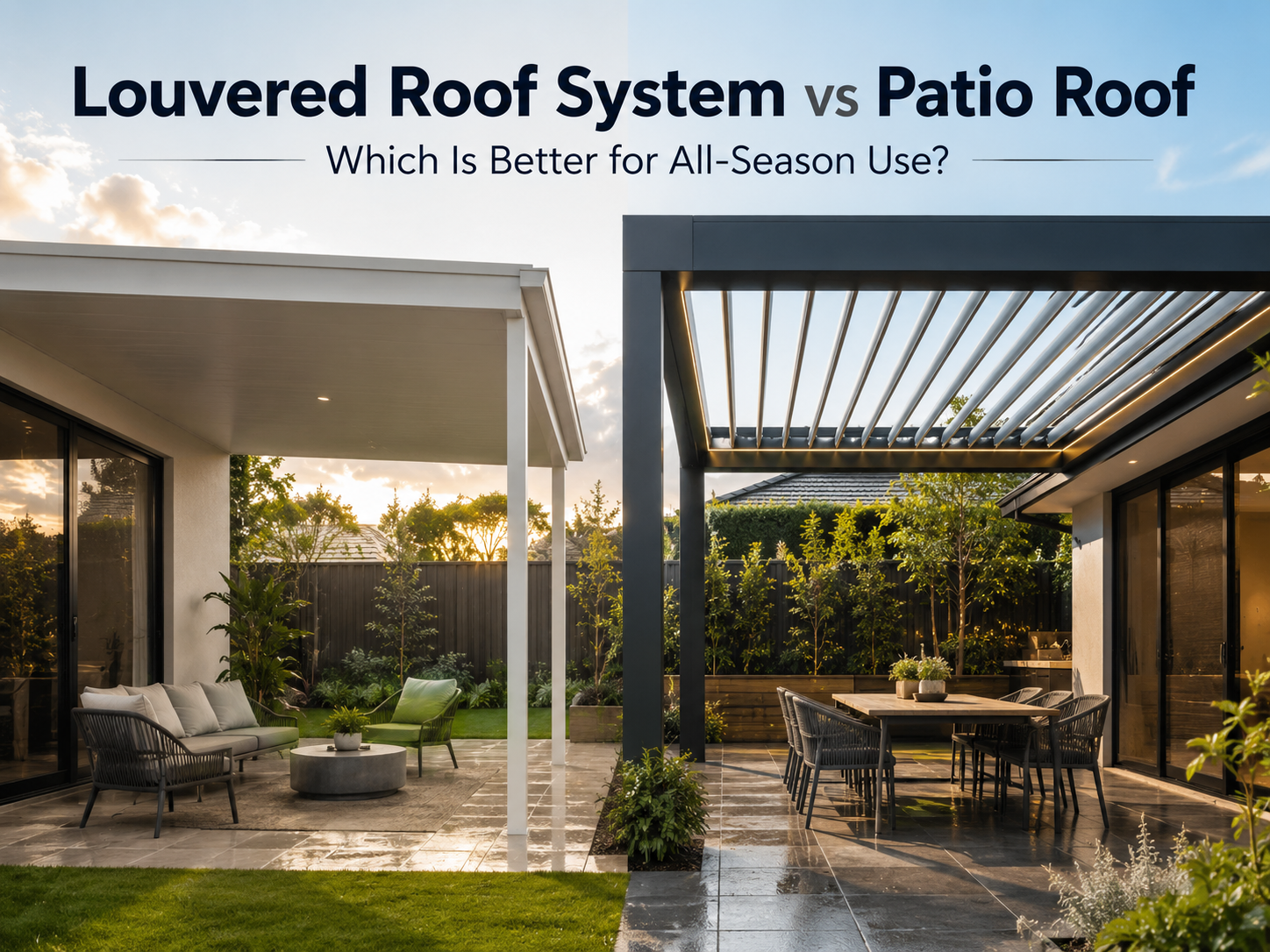
An adjustable louvered roof system and a fixed patio roof can both protect an outdoor area, but they are designed around different priorities. A fixed roof provides constant shelter. A louvred pergola gives the user control over daylight, shade and roof-level ventilation.
For a side path, laundry exit or storage zone, simple permanent cover may be the sensible choice. For a patio used for breakfast, outdoor dining, entertaining or poolside relaxation, the ability to adjust the roof can make the space useful for more hours of the day and more months of the year.
Choose fixed cover when
The job is mainly shelter
The area is used briefly, permanent shade is acceptable, and fewer moving components matter more than changing light or airflow.
Choose a louvred roof when
The patio is a real living space
The same area needs morning light, midday shade, evening ventilation and a practical response to short periods of light rain.
01 · Start with the main difference
Louvered Roof System vs Fixed Patio Roof: Quick Comparison
The key difference is not simply whether the roof keeps sun or rain off the patio. It is whether the roof condition can change after installation. A fixed patio roof stays in one position. A louvred roof can open, angle or close, allowing the homeowner to respond to different times of day without changing the furniture layout or abandoning the space.
| Decision point | Fixed patio roof | Louvered roof system |
|---|---|---|
| Daylight | One permanent shade level | Open or tilt the blades to admit more light |
| Summer comfort | Reliable overhead shade, but heat may collect below | Tilted blades can shade the area while allowing warm air to rise |
| Rain response | Constant cover with a fixed runoff direction | Close for light rain, then reopen after the shower |
| Complexity | Fewer moving components | Moving blades, drainage channels and optional motorisation |
| Best setting | Utility cover and low-use areas | Dining, lounging, entertaining and poolside areas |
| Main buying reason | Simple, permanent shelter | More control over how the patio feels |
How the difference feels during one day
Morning
Bring light back to the house
Opening the louvres can brighten a breakfast patio and reduce the dark band that a permanent roof may create beside glazed doors.
Midday
Create shade without sealing in heat
Tilting the blades can reduce direct sun over the table while leaving a route for warm air to move upward.
Evening
Ventilate after the hottest part of the day
Reopening the roof can help a paved patio release stored heat before dinner or evening entertaining.
02 · Separate roof performance from site planning
Sun, Airflow, Rain and Drainage
A roof can improve comfort, but it cannot correct every site problem. Orientation, low-angle sun, nearby walls, paving levels, door thresholds and prevailing wind still affect the result. The most reliable buying decision separates what the roof can control from what must be resolved through layout and installation.
The Australian Government’s YourHome shading guidance explains why adjustable shading is useful where seasonal sun angles change. That principle is especially relevant when a patio sits beside living-room glass or is used at more than one time of day.
What the roof can control
- The amount of overhead daylight entering the patio.
- Direct overhead shade during hotter periods.
- Roof-level ventilation when the blades are open.
- Light-rain response when the blades are closed.
- How quickly light and airflow return after a shower.
What the site still has to solve
- Low western sun entering from the side.
- Wind-driven rain under an open edge.
- Water pooling around low paving or door tracks.
- Reflected glare from water, glass or pale surfaces.
- Furniture placement, post positions and access clearance.

Rain planning: the important limitation
A closed louvred roof can improve usability during light rain, but an open-sided structure should not be described as an indoor room. Side rain can still enter, especially on exposed sites. Water performance also depends on correct assembly, clear drainage channels and a suitable discharge path.
Before ordering, identify where roof water will leave the structure and confirm that it will not discharge toward a low threshold, garden bed that already floods, pool equipment or an access path.
03 · Compare the real ownership routine
Maintenance, Cleaning and Long-Term Use
A fixed roof has fewer moving parts, but it is not maintenance-free. Leaves, dust, bird mess and blocked gutters can still cause staining or poor drainage. A louvred roof adds blades, channels and—on motorised models—electrical components, so access and routine inspection become more important.
| Ownership task | Fixed patio roof | Louvred pergola |
|---|---|---|
| After windy weather | Check gutters and roof edges for leaves | Clear leaves from blades, channels and moving zones |
| Routine cleaning | Wash panels or roofing and flush the gutter | Rinse the aluminium, clean louvres and flush drainage paths |
| Moving parts | Usually limited | Check smooth blade operation and keep obstructions clear |
| Motorised system | Not applicable | Keep the motor area free of dust and follow product care guidance |
| Best design decision | Provide safe gutter access | Provide access to blades, channels and control components |
Near trees
Prioritise easy access and more frequent debris removal. Fine leaves can collect in narrow drainage routes even when the structure looks clean from below.
Coastal or exposed areas
A regular fresh-water rinse can help remove salt or airborne residue. Follow the manufacturer’s care instructions for the specific finish and location.
Motorised models
Motorisation improves convenience, but installation quality and unobstructed operation matter. Do not operate the blades when debris is trapped in the roof.
04 · Match the roof to the way the area is used
Which Roof Type Fits Each Patio Use Case?
Do not choose from patio size alone. A small patio used every day may benefit more from adjustable louvres than a large utility area used for ten minutes at a time. Use pattern determines the roof type; dimensions then help determine the model.
Back door or laundry exit
Fixed roof usually wins
The main requirement is a dry transition area, not changing shade or ventilation.
Outdoor dining
Louvred roof usually wins
Meals happen at different times, so adjustable light, shade and ventilation have daily value.
BBQ and lounge zone
Louvred roof usually wins
Opening the roof can support heat release while preserving useful shade over seating.
Poolside patio
Louvred roof usually wins
Reflected glare and changing sun angles make flexible shade more useful than one fixed setting.
Storage or equipment area
Fixed roof usually wins
Constant shelter and a straightforward structure matter more than occupant comfort.
Exposed side boundary
Roof choice plus side control
The roof handles overhead conditions; a blind or suitable screen may still be needed for wind, privacy or low sun.
When does the additional complexity make sense?
A louvred roof earns its place when the adjustment will actually be used. If the patio hosts several activities, sits beside important indoor glazing, or experiences very different morning and afternoon conditions, control has practical value. If the structure only protects bins, a doorway or infrequently used storage, a fixed roof may remain the more proportionate solution.
05 · Narrow the adjustable-roof options
Everpergo P120 vs P180 vs P180 Pro
Once an adjustable roof is the right category, compare models by control method, structural scale, available sizes and installation needs. The best choice is not automatically the largest model. It is the simplest system that comfortably supports the span, use pattern and level of convenience required.


Manual or motorised?
Manual control is practical when the roof is compact, easy to reach and adjusted occasionally. It keeps the operating system simple and can suit buyers who prioritise value over automation.
Motorised control becomes more useful when the roof is larger, adjusted several times a day, or integrated into an entertaining area where convenience matters. It should be treated as a functional upgrade, not just a premium label.
Project information to prepare before ordering
1. Finished dimensions
Measure the usable patio, not only the paving. Allow for posts, doors, furniture, access and roof overhang.
2. Mounting layout
Confirm whether the project needs a freestanding structure or an appropriate wall-mounted arrangement.
3. Sun and exposure
Record morning and afternoon sun, prevailing wind, nearby trees and the most exposed side.
4. Drainage route
Identify where roof water can discharge without affecting doors, paths, garden beds or equipment.
5. Control and accessories
Decide whether manual or motorised operation is appropriate and whether side blinds are genuinely needed.
6. Installation plan
Confirm installer availability, access for delivery and assembly, and any site-specific approval requirements before purchase.
Product configurations and availability can change. Use the Everpergo comparison page and individual product pages to confirm the current options before placing an order.
06 · Common buying questions
Frequently Asked Questions
Is a fixed roof better for a small patio?
Not automatically. A fixed roof may be enough for a small service area or doorway. A small patio used for coffee, meals or reading may gain more value from adjustable light and ventilation than a much larger storage area.
Can a louvered roof system keep a patio dry?
Closed louvres can improve protection during light rain when the system is correctly installed and the drainage paths are clear. However, the structure remains open-sided, so wind-driven rain can still enter from the edges.
Does opening the louvres really improve airflow?
Opening or angling the blades creates a roof-level path for warm air to move upward. The result still depends on the wider site, surrounding walls and wind conditions, but the roof is less likely to trap heat than a fully closed fixed surface.
Should I choose a wall-mounted or freestanding pergola?
A wall-mounted layout can create a direct connection to the house when the wall and site are suitable. A freestanding structure gives more placement flexibility and may be preferable beside a pool, in a garden or where attachment to the building is not appropriate.
When is a Wind Blind worth adding?
A blind is most useful on the side affected by low afternoon sun, light wind or overlooking. It should solve a known exposure problem rather than being added automatically to every side of the pergola.
Which Everpergo model is the best starting point?
P120 is the compact manual option, P180 offers the broadest everyday flexibility with manual or motorised choices, and P180 Pro is designed around larger motorised layouts with double-layer louvres. Patio dimensions, desired control and installation requirements should decide the model.
Make the next step specific
Compare the Roof Type First, Then Confirm the Model
Choose fixed cover when the area mainly needs simple shelter. Choose an aluminium louvred pergola when the patio is used as a living space and changing light, heat and airflow affect comfort. Before requesting advice, prepare the patio dimensions, preferred layout, main use, sun direction, drainage route and any side-exposure concerns.
Share:
Louvre Roof System for Australian Homes: Why Adjustable Shade Matters
Power Planning for a Motorised Pergola: What to Check Before Installation