

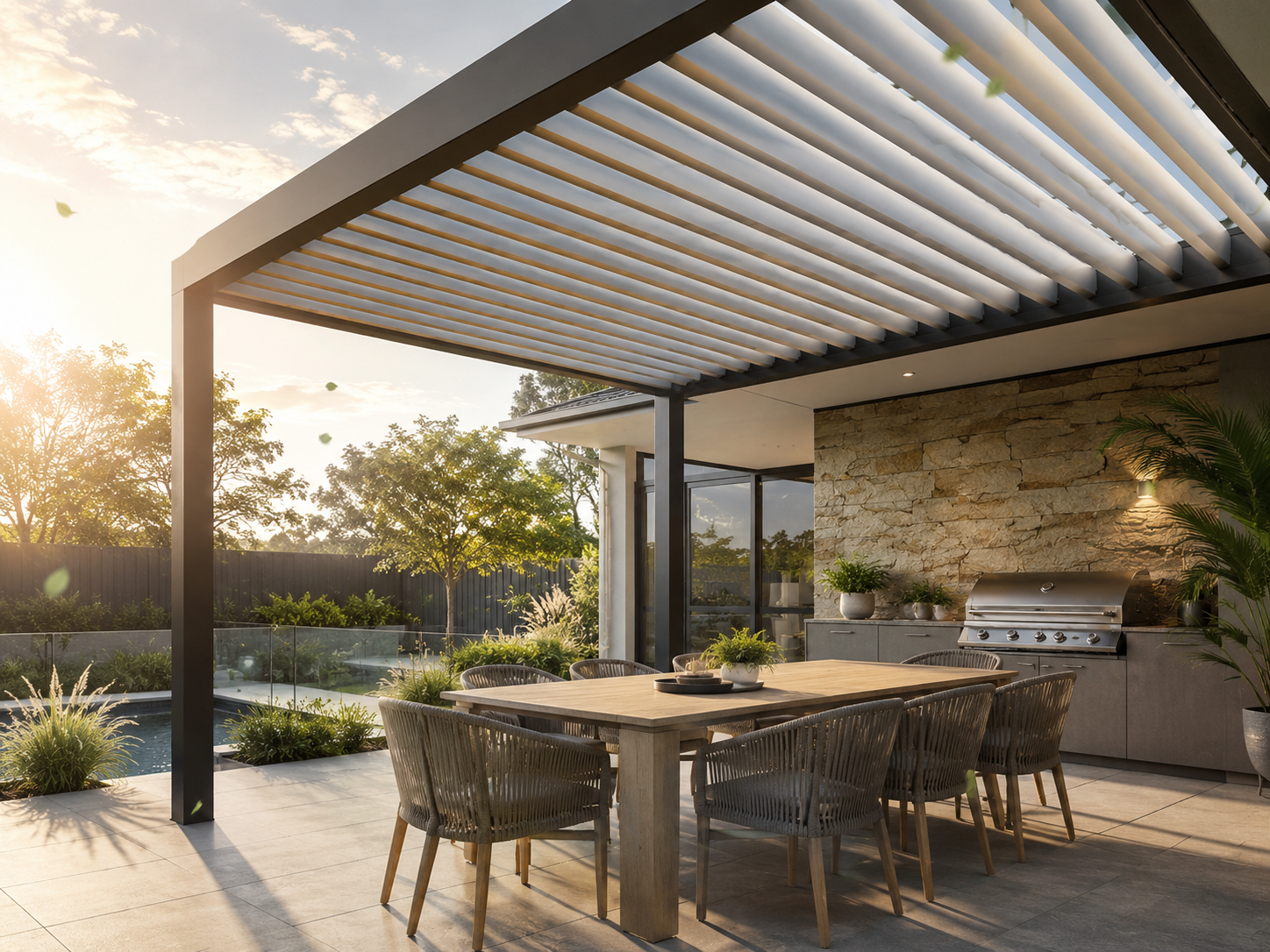
At 8 am, a patio can feel fresh and easy. By 1 pm, the same table may feel too bright, too hot, and hard to sit around. That is where an adjustable pergola roof makes practical sense. By changing the louvre angles through the day, an outdoor area can handle morning sun, midday heat, afternoon glare, light rain, airflow, and everyday dining with far more control than a fixed cover.
The useful part is not complicated. A louvred roof can open for light and air, tilt for softer shade, and close further when stronger cover is needed. Instead of treating a pergola as one fixed setting, this guide looks at how the roof behaves across a normal Australian day.
Morning sun
Morning sun is usually the easiest part of the day to enjoy outdoors. It brings warmth to pavers, timber decking, seat cushions, and the side of the house. However, low-angle light can still hit a breakfast table straight across the eyes, especially on east-facing patios.
That is where louvre angles become useful. A slightly open setting can keep the patio bright while softening direct glare. The roof does not need to shut the sky out. Instead, it only needs to break up the sharpest morning light.
For a compact courtyard, that small difference matters. A fully closed roof can make a small space feel dull at 8 am. Meanwhile, a partial opening keeps the air moving and lets the space feel awake, not boxed in.
 P120 works well for compact patios, small courtyards, and outdoor corners where soft morning shade matters. View P120 Pergola
 A better setting for breakfast spaces
For breakfast areas, the best setting is often not fully open and not fully closed. A mid-way position can let light filter through while keeping the main table surface easier to use. Coffee cups, plates, and glass tabletops also feel less harsh under broken light.
In a wall-mounted layout beside sliding doors, the effect is even clearer. The door opens, the table sits close to the kitchen, and the patio feels like part of the morning routine. Therefore, the louvres should support that easy movement between inside and outside.
The Australian Government’s YourHome shading guide explains that shading works best when it responds to orientation and sun direction. In practical terms, this means morning shade should be planned differently from afternoon shade.
Morning use tip
Check the outdoor table between 7:30 and 9:00. If light hits faces or the main table surface, a gentle louvre opening will usually feel better than a completely open roof.
Midday heat
Midday heat is less forgiving. Around 12:30, the sun sits high, pale paving reflects more light, and outdoor chairs can become uncomfortable within minutes. So the roof setting should change from soft light control to stronger overhead shade.
An adjustable pergola roof helps because the louvres can move closer together for deeper shade. At the same time, a small opening can help warm air rise and leave through the roof line. That balance matters on still summer days, when shade alone can feel a little heavy.
For everyday patios, the shaded zone should match the actual lunch setup. If the table is covered but the path from the kitchen is exposed, plates and drinks still move through full sun. Therefore, pergola size and placement should follow the way the space is used, not only the shape of the slab.
 P180 suits everyday patios where lunch shade, airflow, and outdoor seating comfort all need to work together. View P180 Pergola
 Shade first, then airflow
At midday, shade should come first. The roof needs to protect the table, seat cushions, armrests, and paving below. After that, airflow becomes the detail that stops the area from feeling flat and still.
For example, a mostly closed roof can make lunch more comfortable by reducing direct overhead sun. However, if the air under the roof starts to feel warm, a slight opening can help the heat move upward. It is a small adjustment, but it changes how the space feels.
This is the practical advantage over a fixed patio roof. A fixed cover can block sun, but it cannot respond when the weather turns humid or the breeze drops. With an adjustable pergola roof, the outdoor area can shift between deeper shade and more airflow without changing the furniture layout.
Afternoon glare
Afternoon glare is often the most irritating part of the day. The worst heat may have passed, yet the patio still becomes hard to use. Around 4 pm, low sun can hit glass doors, pale paving, pool water, and outdoor tables at a sharp angle.
At this time, a flat closed roof may not solve the whole problem. The glare is not always coming from above. Instead, it may come under the roof edge or bounce from a nearby surface.
That is why louvre direction matters. By shifting the louvre angles toward the light source, the roof can soften the bright line without making the patio feel too dark before evening. The setting should feel calm, not shut down.
Late-day comfort needs direction, not just shade
A west-facing patio often has a short but uncomfortable glare window. It may happen just as the outdoor area should be most useful, after work or before dinner. In that moment, the roof setting should target eye-level brightness as much as overhead sun.
A simple check helps. Place a chair where people actually sit at 4:30. Then look at the table surface, the eye line, and nearby glass. If the brightest line hits the face or a screen, the louvres need to tilt differently.
For some spaces, side support may also be useful. Roof angle can reduce overhead and angled light, but very low sun can still enter from one exposed side. In that case, planting, a screen, or a side blind can support the roof without making the area feel closed.
Afternoon layout notes
- Keep lounge chairs away from the brightest western edge where possible.
- Watch for glare bouncing from glass doors, pale paving, and pool surfaces.
- Use the roof angle first, then add side support only where the glare remains uncomfortable.
Light rain
Light rain can change an outdoor plan in seconds. A dinner table may be set at 6:15, then a short shower arrives before the food is served. A more closed louvre position can help reduce rain falling directly from above and give the space a calmer buffer.
Still, a pergola remains an outdoor structure. Wind direction, rain intensity, open sides, and site exposure all affect comfort. So the sensible expectation is better shelter during light rain, not a fully sealed indoor room.
After the shower passes, the roof should not stay closed all evening. Opening the louvres again helps damp air move out, especially after warm weather. This simple habit keeps the patio feeling fresher for the next meal or the next morning.
 A wind blind can support exposed patios where side breeze, low sun, or light rain often enters from one direction. View Wind Blind
 Rain shelter works best with a routine
A useful light rain routine is simple. Close the louvres when rain begins, keep delicate items away from open edges, then open the roof again when the shower has passed. This keeps the space protected when needed and breathable afterwards.
In outdoor dining areas, that routine is practical. Plates may stay on the table during drizzle. Cushions are less exposed from above. Meanwhile, the space does not feel like a dark covered box once the rain moves on.
For patios with trees nearby, airflow also helps after rain. Leaves, moisture, and dust can settle on surfaces. A roof that opens again gives the area a better chance to dry naturally.
Dining and BBQ areas
Dining and BBQ areas make louvre angles easy to understand. The setting affects how hot the cook feels, how smoke moves, how plates sit in the sun, and whether the table stays pleasant after food arrives.
For BBQ areas, airflow should not be treated as a small detail. A fully still covered space can hold smoke and cooking heat near the table. Therefore, during active grilling, a partly open setting often feels better than closing the roof completely.
After cooking, the same roof can shift again. The louvres may close further for late sun, open slightly for breeze, or move toward shelter if clouds roll in. This is where an adjustable pergola roof feels less like a feature and more like a useful daily habit.
 P180 Pro suits larger alfresco zones where dining, lounging, and regular outdoor entertaining share one covered area. View P180 Pro Pergola
 BBQ planning needs breathing space
A BBQ should sit where heat and smoke can move away. If the grill is crowded between a wall, table, and roof line, every setting feels harder. However, when the BBQ sits near an open edge, the louvres can help warm air rise and leave.
Furniture spacing matters too. A hot tray needs a clear path from the cooking area to the table. The roof can improve shade and comfort, but a cramped layout will still feel awkward during dinner.
A practical outdoor dining plan has three zones: cooking, dining, and sitting. The cooking zone needs airflow. The dining zone needs shade. The sitting zone needs comfort after the meal. Louvre angles help those zones work together without forcing the patio into one fixed mode.
Dining comfort changes with the meal
Breakfast may need soft sun. Lunch may need stronger shade. Dinner may need shelter from light rain or a little more warmth after sunset. The same roof can support each moment because the louvres do not stay in one position all day.
For larger alfresco areas, the model choice should come from the activity plan. A long dining table, an outdoor lounge, and a BBQ edge need more coverage than a two-chair courtyard. As a result, a broader modular pergola system can feel more balanced than forcing a compact structure over a large outdoor routine.
Choosing the right setup
The strongest reason to choose an adjustable pergola roof is not one dramatic feature. It is the small control it gives across an ordinary day. Morning sun, midday heat, afternoon glare, light rain, and BBQ airflow all need different settings.
That is why model choice should start with the real outdoor routine. A compact courtyard does not need the same structure as a wide alfresco zone. A west-facing deck does not behave like a shaded garden corner. The better plan starts with the sun path, the table position, the cooking area, and the hours when the space gets used most.
Best fit by outdoor area
Plan the pergola around real use, not just the floor size
Everpergo aluminium louvred pergolas and modular pergola system options can support compact courtyards, everyday patios, and larger alfresco settings. For the clearest recommendation, share the outdoor area size, preferred placement, main sun direction, and the comfort issue that matters most.
Three practical steps before choosing a setup
- Map the sun at three times: check the area around 8 am, 12:30 pm, and 4:30 pm. This shows whether the main issue is morning sun, midday heat, or afternoon glare.
- Mark the activity zones: note where the table, BBQ, lounge chairs, and walking path will sit. Shade should land where the daily routine actually happens.
- Add accessories only where needed: start with the roof, then consider side comfort, lighting, or heating if one specific moment still feels uncomfortable.
FAQ
How do louvre angles affect airflow under a pergola?
Louvre angles change how warm air leaves the roof area. A partly open setting can help air rise through the louvres, while a more closed setting creates deeper shade. Therefore, airflow and shade usually need to be balanced through the day.
Is a louvred roof helpful for morning sun?
Yes. Morning sun can be softened without making the patio feel dark. A partial opening often works well because it keeps natural light in the space while reducing direct glare across tables, chairs, and glass surfaces.
Can a louvred pergola help during light rain?
A closed louvre setting can help reduce rain falling directly from above. However, side-blown rain can still enter open sides. For that reason, a louvred pergola should be treated as practical outdoor shelter, not a sealed indoor extension.
What roof setting works best for BBQ areas?
During active cooking, a partly open roof setting is usually more comfortable because smoke and warm air need a clear path upward. After cooking, the louvres can move closer for shade, light rain shelter, or evening comfort.
Which Everpergo pergola suits a small patio?
P120 is a practical option for compact patios, courtyards, and smaller garden areas. P180 and P180 Pro are more relevant when the covered zone is larger, more exposed, or expected to support dining, lounging, and regular entertaining.
Share:
Can a Pergola Kit Work for a Covered Patio? Size, Posts and Drainage Checklist
Louvre Roof System for Australian Homes: Why Adjustable Shade Matters