

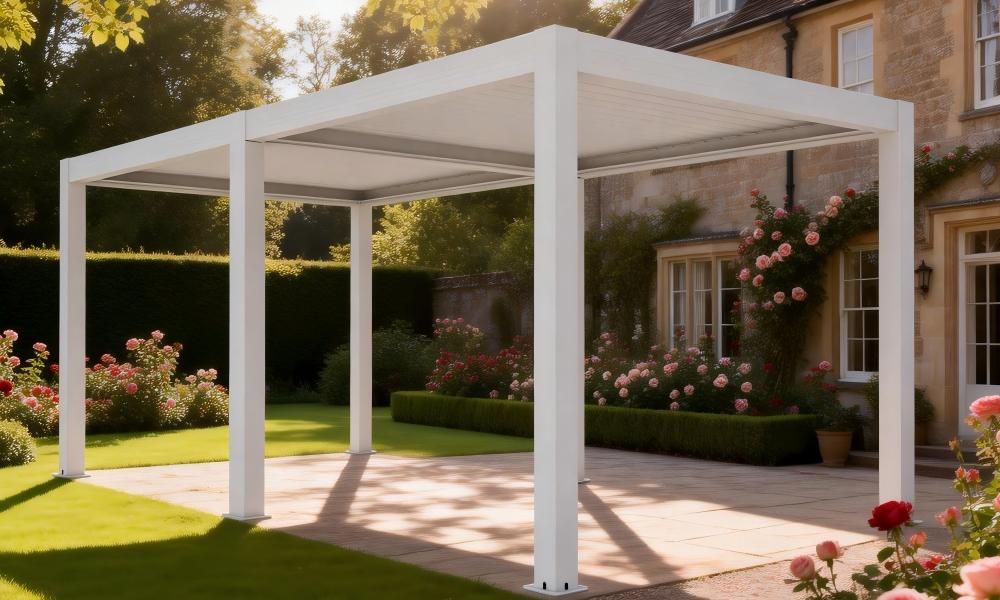
A covered pergola often feels like the obvious answer at first. More shade. More shelter. Fewer weather-related compromises. Still, that first reaction can be misleading. In a real Australian backyard, the better choice depends less on the word “covered” and more on what actually happens in the space on a hot afternoon, during a quick shower, or at the tail end of a long dinner. That is where roof style becomes a practical decision, not just a visual one.
Many comparisons treat this as a clean split: covered pergola on one side, open roof pergola on the other. Real outdoor spaces rarely work that neatly. A patio beside the kitchen behaves differently from a poolside sitting area. A dining zone that stays active until 8 pm needs something different from a quiet backyard pergola used for coffee in the morning. Once those everyday details are taken seriously, the roof question becomes easier to answer.
Everpergo’s public range is built around that kind of flexibility. The brand offers all-aluminium louvred pergolas with manual or motorised options, custom sizes, and both freestanding and wall-mounted layouts, designed for Australian conditions. That matters because the strongest solution is rarely a roof that stays in one mood all year. More often, it is a roof that can respond to the way the space is actually used.
The better question is not simply covered or open
The real question is how the space should feel and function across the week. Think about the backyard at three different moments. First, a hard 3 pm sun on a January afternoon. Then, a breezy evening when dinner drifts outside. Finally, a day with light rain, when the table is already set and the chairs are already out. The right roof should make sense in all three moments, not just in one carefully staged version of them.
A covered pergola usually makes the most sense when the area needs reliable comfort. That often applies to patios, family spaces near the house, and outdoor dining zones where people stay longer and furniture remains in place. A roofed pergola helps those spaces feel settled. It also reduces the constant need to adjust everything around the weather.
An open roof pergola leans in a different direction. It suits spaces where air, light, and openness are part of the experience. A garden-side seating corner, a more relaxed backyard pergola, or a pool edge often benefits from that lighter overhead feeling. Too much fixed cover in those areas can flatten the mood of the space and make it feel heavier than it should.
This is why adjustable louvres matter so much. They allow one structure to move between shelter and openness instead of forcing a backyard into one fixed answer. In practical terms, that means the pergola can behave like a covered space when protection matters and feel more like an open roof pergola when mild weather, fresh air, and a clearer view overhead are the bigger priorities.
Patio spaces usually reward stronger roof control
Patios tend to reveal the answer quickly. They sit close to the house. They carry regular foot traffic. They often become the first outdoor area that starts to feel like an extension of daily life rather than just part of the yard. Once that happens, the roof needs to do more than create occasional shade.
It helps to picture ordinary patio use instead of ideal patio use. A lunch that runs twenty minutes longer than planned. A late afternoon coffee when the western sun starts dropping lower. A quick shower rolling through while cushions are still outside. In each of those moments, stronger roof control makes the space easier to live with. That is why a covered pergola so often feels right over a patio.
At the same time, too much fixed cover can make a smaller patio feel darker than it needs to be. This is where many projects lose balance. A patio should feel sheltered, but not shut down. A roof that stays heavy overhead in every season can take away the lightness that makes outdoor living enjoyable in the first place.
The stronger answer is usually controlled cover rather than constant cover. Everpergo’s public range supports that well, with manual and motorised louvred roofs, custom sizing, and both freestanding and wall-mounted layouts. For a patio, that flexibility matters more than a long technical checklist because the space has to respond to changing light and changing use throughout the day.

There is also a visual reason patios often benefit from a roofed pergola. Once the space carries a table, a side bench, planters, and lighting, it stops feeling like spare outdoor square metres. It starts feeling like a room with an open edge. Clearer roof definition helps that shift. The area feels more intentional, and the furniture sits more naturally under it.
Outdoor dining is where a covered pergola often proves its value
Dining is one of the clearest arguments for stronger cover. A quick coffee can tolerate a few compromises. A full meal usually cannot. Plates stay out longer. Drinks sit in direct light. Chairs remain occupied for an hour or more. By the time lunch becomes a long afternoon or dinner drifts well past sunset, the roof is no longer just part of the backdrop. It starts doing real work.
This is why outdoor dining areas usually lean toward a covered pergola more decisively than lounge spaces do. The area needs to feel dependable. That does not mean fully enclosed or permanently dark. It means the space should stay comfortable when conditions change, rather than falling apart as soon as the sun sharpens or a light shower arrives.
A roofed pergola with adjustable louvres usually handles this balance well. It gives the dining setting enough protection to feel reliable, while still allowing the roof to open when airflow and natural light matter more. On a hot midday lunch, stronger cover is the priority. Later in the evening, when the air cools and the light softens, a more open feel can make the same space much more pleasant.
Placement matters here too. A wall-mounted pergola beside the kitchen or living room usually behaves more like an outdoor room than a freestanding structure deeper in the yard. That pushes the design toward stronger roof control. Everpergo’s public range includes both wall-mounted and freestanding layouts, which is useful because dining beside the house and dining at the far end of the lawn are not the same design problem.

Dining is also where accessories become more relevant than many people expect. Sometimes the biggest comfort issue is not overhead sun. It is low-angle side glare at 5 pm, a breeze running across the table, or a lack of definition after dark. Everpergo publicly offers wind blinds, frameless glass doors, and LED strip lighting, which means the final comfort of the space does not depend on the roof alone.
Lounge areas need atmosphere as much as shelter
A lounge space follows a different rhythm. The use is softer. Sometimes it is a short break with a coffee. Sometimes it is a quiet drink after work while the heat starts leaving the paving. In those moments, the roof is doing something subtler. It is shaping the atmosphere, not just protecting the furniture.
This is where an open roof pergola often becomes more attractive. A lounge area usually feels better with a little more breathing room overhead. Airflow matters. Filtered light matters. The space should still feel like part of the garden, not like an outdoor room that has been pushed too far indoors in character.
Still, a completely open top is not always the smartest answer. Australian weather is too changeable for that to suit every backyard. A space with no roof control can become unusable on hot afternoons, ignored after rain, or uncomfortable once the air goes still. That is why the most satisfying result often comes from a pergola that can feel open when the weather allows it and sheltered when the site demands it.
Everpergo’s louvred aluminium systems make sense in exactly that middle ground. Public product information positions them around adjustable control of sunlight, airflow, and weather protection rather than around a fixed all-open or all-covered approach. For lounge use, that balance is hard to beat.

Smaller spaces make this even clearer. In a narrow courtyard or side yard, too much fixed cover can make the whole setting feel pressed down. A lighter overhead character usually suits those sites better. That is one reason Everpergo’s public P120 is positioned as a more compact, simpler option for smaller spaces where proportion matters just as much as performance.
Poolside areas should almost never be treated like patios
Pool areas are where roof decisions most often become too heavy. The instinct is easy to understand. Water reflects light. The paving gets hot. Shade sounds like the answer. But the whole point of a poolside setting is not just comfort. It is also openness, freshness, and that sense that the sky is still part of the experience.
That is why blanket coverage often feels wrong around a pool. A covered pergola works beautifully over a shaded seating cluster, a row of loungers, or an outdoor dining spot near the water. Those are the areas where people stay longer and where glare becomes tiring. The broader pool edge usually benefits from more visual openness.
This is one of the clearest answers to the question, “Do I really need fully covered?” Near a pool, often not. Or at least, not everywhere. Selective cover nearly always feels more natural than covering the whole zone with one continuous overhead statement.
An open roof pergola feel usually suits the wider pool setting better, especially where airflow is already good. Then, where genuine shelter is needed, adjustable louvres bring the practical benefit back in without making the entire area feel enclosed. That balance preserves the character of the space instead of flattening it.
 round poolside and exposed seating areas, selective side protection can improve comfort without over-covering the whole zone.
A side accessory can matter just as much as the roof in these settings. Pool areas often catch low sun or crosswinds from one direction. Everpergo’s public wind blind is designed to reduce side sun, light rain, and wind while still allowing airflow and outward views. In practical terms, that means better comfort where people actually sit, without turning the area into a sealed enclosure.
The simplest way to choose is to map the activity first
The easiest way to make the roof decision is to stop looking at product names for a moment and study the space as a sequence of uses. Where does lunch actually happen? Which corner still feels pleasant after 6 pm? Where does someone naturally sit when the backyard is hottest? Which area needs to stay ready even when the weather shifts?
Those answers usually reveal the roof logic faster than any feature list. Dining spaces and patios beside the house tend to need stronger cover. Lounge areas and garden-edge seating often want more air and more visual lightness. Poolside layouts usually want a mixed solution: shelter where people stay put, openness where the area needs to feel bright and fresh.
It also helps to check the site at two difficult times rather than one ideal time. A west-facing patio at 4 pm tells a different story from the same space at 9 am. A breezy evening can reveal whether the real issue is side protection rather than more overhead roof. Those small observations often lead to better decisions than a long round of product comparison alone.
Once that activity map is clear, product selection becomes easier too. Everpergo’s public range places the P120 in smaller, simpler spaces, the P180 as the most popular all-round residential option, and the P180 Pro as the stronger solution for larger spans and heavier demands according to the comparison page. Those differences become meaningful only after the space itself has been read properly.
That is also why the covered pergola customisation page is such a practical starting point. It keeps the focus on layout, sizing, and use rather than forcing the decision into a fixed template too early. From there, the public compare pergola models page is a useful next step for narrowing the range.
Maintenance and installation still matter to the roof choice
Roof style is not only about how a pergola looks on day one. It also shapes how easy the structure feels to live with over time. A pergola that takes on regular sun, rain, falling leaves, and coastal air becomes a working part of the home’s exterior. That is worth acknowledging early, because long-term satisfaction usually comes from realistic choices, not just attractive ones.
Everpergo’s public maintenance guidance is straightforward on this point. It recommends periodic checks of joints, tracks, gutters, motors, and roof slats, along with regular debris removal and more frequent cleaning in harsher environments such as coastal areas. That kind of guidance matters because a roofed pergola should be treated as a practical outdoor structure, not as something that can simply be ignored once installed.
Installation is part of the same picture. Where builder-led or DIY-led projects are involved, the scale and configuration of the pergola should match the site and the intended use. Everpergo’s public FAQ states that the brand does not directly provide installation service, but can recommend experienced installers and provide installation guides plus technical support. That is useful because it keeps the project grounded in practical planning rather than assumptions.
It also helps to think ahead. If the space may later need a wind blind, frameless glass doors, or integrated LED strip lighting, that is best considered from the beginning. Everpergo publicly offers all three, which means the pergola can be planned as a flexible outdoor system rather than a one-step purchase that has to solve everything on day one.

A practical verdict for Australian backyards
For most homes, the best answer is not a permanently covered roof or a permanently open one. It is controlled cover. Patios and outdoor dining areas usually need more of it. Lounge spaces usually need more breathing room. Poolside areas usually need a selective mix rather than one uniform solution across the entire edge.
That is why this comparison matters. “Covered pergola vs open roof” sounds like a simple product choice, but the better answer comes from how the backyard is actually used. In many cases, a covered pergola that can still open up when airflow, light, and a more relaxed outdoor feel matter most is the strongest long-term fit.
Everpergo’s public positioning supports that flexible view well. The range is built around all-aluminium louvred pergolas with manual or motorised operation, freestanding or wall-mounted layouts, custom sizes, nationwide delivery, a Dandenong Melbourne warehouse and showroom, and published warranty coverage including a 10-year structural warranty and a 2-year motorised warranty. Those details matter because a good roof decision should still feel supported once the space moves from planning into everyday use.
FAQ
The questions below reflect the hesitation most people actually have when comparing a covered pergola with a more open roof style.
Do most backyards really need a fully covered pergola?
Not necessarily. In many Australian homes, a fully covered roof sounds reassuring at first, but daily use often tells a different story. A dining area beside the house may benefit from stronger shelter because meals last longer, furniture stays in place, and light rain can interrupt the space quickly. A garden lounge or poolside sitting area is different. Those spaces often feel better with more air, more light, and a roof that does not sit too heavily overhead.
The better question is not whether full cover sounds safer. It is whether the space needs dependable protection every week, or whether it mainly needs to feel comfortable and open most of the time. That distinction usually leads to a better decision than choosing the most enclosed option too early.
Will a covered pergola make the backyard feel dark or closed in?
It can, if the roof is too heavy for the way the space is used. That is one of the most common concerns, and it is a fair one. In a smaller patio or a narrow side yard, too much fixed cover can flatten the space. The backyard loses some of its openness, and what should feel relaxed starts to feel a little shut down.
That is why roof control matters so much. In practical terms, a pergola tends to work best when it can create shelter during strong sun or light rain, but still allow the space to breathe when the weather is mild. The goal is not simply more roof. The goal is a roof style that keeps the area comfortable without taking away the outdoor feeling that made the project worthwhile in the first place.
Which areas usually benefit most from a covered pergola?
Patios and outdoor dining areas are usually the clearest candidates. These are the spaces where chairs stay outside, meals run longer than expected, and the area needs to work not only on perfect days, but also on hot afternoons or during a passing shower. In those settings, a covered pergola often feels practical rather than excessive.
Poolside zones and casual lounge areas are more nuanced. A shaded sitting pocket near the pool can work beautifully under stronger cover, especially where glare is sharp in the afternoon. But covering the whole pool edge often feels too heavy. The best result usually comes from matching the roof style to the activity underneath it, rather than treating the whole backyard as if it needs one single answer.
What is the best way to choose between a covered roof and a more open feel?
The most reliable way is to think about how the space will actually be used on an ordinary week. Picture the area at three moments: a hot afternoon, a breezy evening, and a day with light rain. That simple exercise often reveals more than a long list of product features.
If the space is mainly for dining, everyday family use, or furniture that stays outdoors year-round, stronger cover usually makes sense. If the area is more about quiet sitting, garden views, or a lighter poolside atmosphere, a more open roof feel may be the better fit. In many cases, the strongest solution sits between those extremes: a pergola that can offer shelter when needed, without making the backyard feel permanently enclosed.
Ending CTA
The most reliable way to choose a roof style is to judge the space in motion: lunch in strong light, dinner in softer air, a quick shower rolling through, and the quiet hour after sunset when the backyard either works beautifully or gets ignored.
Start there. Then match the structure to that pattern. For projects that need flexibility rather than a fixed extreme, the covered pergola customisation page is the strongest starting point.
Share:
Pergola Price Guide: Budget, Mid-Range and Premium Options
Louvre Roof Pergola Benefits for Sun, Rain and Airflow