

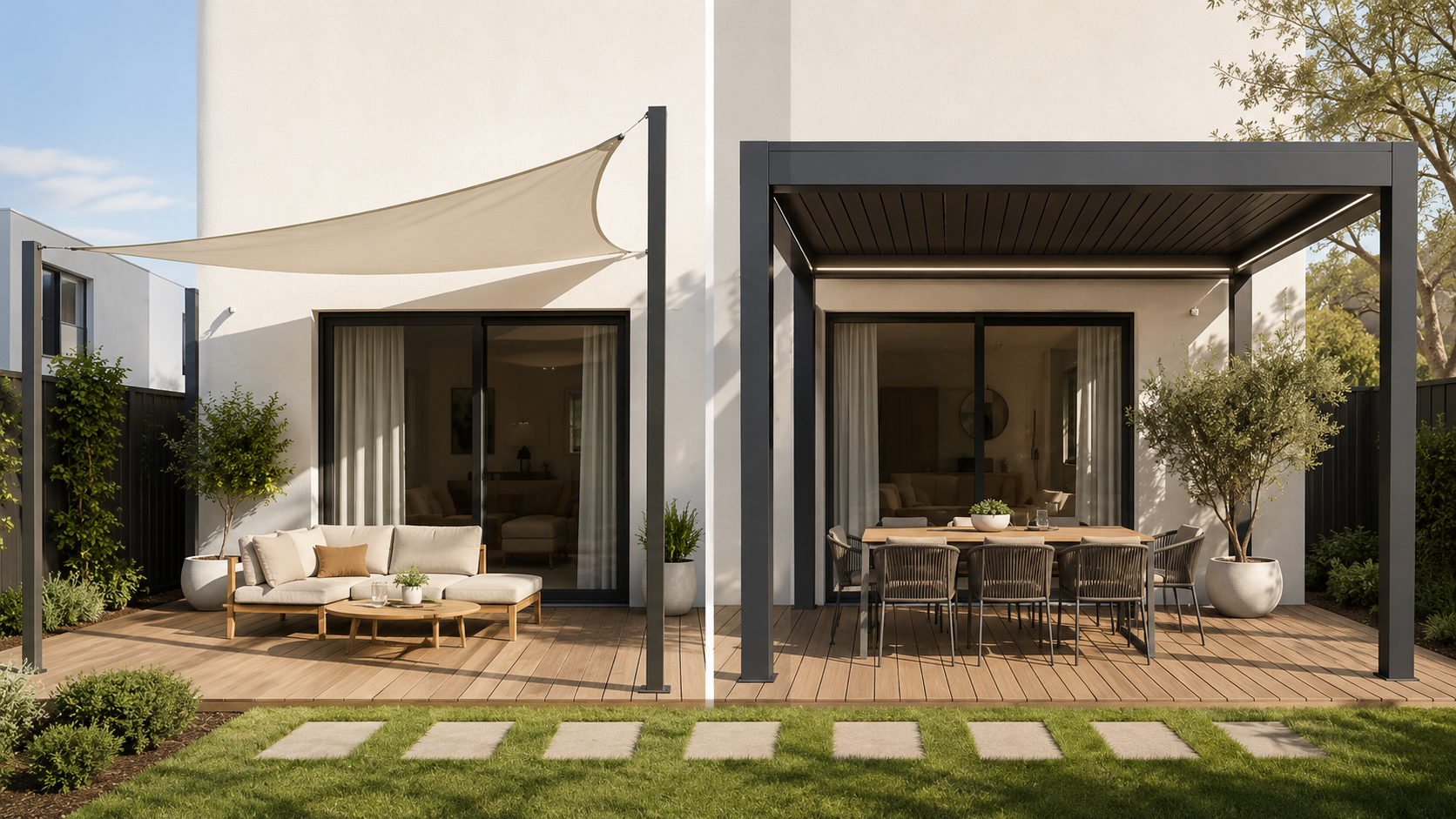
A roofed pergola and a shade sail can both make a hot patio easier to use. However, they solve different outdoor problems. A shade sail is mainly a sun filter. A louvred pergola is a more permanent structure that helps manage shade, airflow, light rain, furniture layout, and the feeling of a finished outdoor room.
Why the cheaper shade option often looks right at first
At first glance, a shade sail feels like the easy answer. It is light, simple, quick to install, and easy to imagine in the space. On a bare patio at 1 pm, even a triangle of fabric can make the area look less exposed.
However, the first sunny afternoon is not the full test. The real test comes after wind, late-day glare, a light shower, and several months of everyday outdoor use. That is when the difference between shade and structure starts to show.
A shade sail usually solves one problem: direct sun from above. A pergola solves a wider outdoor living problem. It gives the patio a roof line, a frame for furniture, and a more stable way to manage changing weather.
Simple rule
If the area only needs occasional sun relief, a shade sail can make sense. If the area holds dining furniture, a barbecue zone, poolside seating, or a daily coffee spot, a permanent patio cover usually gives better long-term comfort.
This is why a roofed pergola should not be judged only against the first cost of a shade sail. The better comparison is how often the covered area still feels useful after weather, light, and routine start to change.
The principle: shade is not the same as outdoor comfort
Outdoor comfort has three parts. First, there is sun control. Next, there is airflow. Then, there is confidence in light rain and changing conditions. A shade sail mainly helps with the first part, while a louvred pergola can help balance all three.
In strong sun, fabric shade cuts glare and heat from above. However, the fabric stays fixed. When the sun drops lower in the afternoon, the shaded patch can move away from the table. That is one reason a patio can still feel uncomfortable even after shade has been added.
For Australian homes, outdoor shade should also be judged by orientation and sun angle, not only by how much area it covers at midday. The Australian Government’s YourHome shading guidance explains that shading needs vary by orientation, and that low-angle eastern and western sun often needs more careful control than simple overhead shade.
A louvred roof works differently from a fixed shade layer. The blades can open for light and air, tilt to soften glare, or close when stronger overhead cover is needed. Because of that, the space can respond to the day instead of relying on one fixed shadow.
Rain and airflow need to work together
Rain protection is not only about staying dry for five minutes. It is also about what happens after the shower passes. Does the dining table still feel usable? Is the walking path wet? Can warm air move out from under the cover?
A fixed solid cover can feel protective, but it may trap heat in small courtyards. A sail can feel open, but it does not give the same rain control. Adjustable louvres sit in the useful middle ground because they can help the patio stay more flexible across different conditions.
 View P120 Pergola
Roofed pergola vs shade sail: what each option does well
A shade sail is useful when the job is small and simple. For example, it can soften a hot corner near a garden bed, cover a short sitting spot, or reduce heat over a casual play area. In those places, a relaxed look can be a benefit.
However, a sail becomes less convincing when the space is used several times a week. Dining areas need steadier cover. Poolside seating needs better glare control. A barbecue corner needs airflow, headroom, and a layout that still feels safe and calm.
A pergola is stronger in those daily-use spaces because it frames the area. Posts define the corners. Beams create a ceiling line. The roof gives furniture a natural home, so the patio feels planned rather than temporarily covered.
| Outdoor need | Shade sail | Louvred pergola |
|---|---|---|
| Midday sun | Good for a fixed shade patch | Good, with adjustable light control |
| Low afternoon glare | Depends heavily on angle and anchor points | Better when louvres and side planning are used together |
| Light rain protection | Limited and inconsistent | More useful when the louvres are closed and drainage is clear |
| Finished patio look | Casual and temporary | Structured, cleaner, and more permanent |
| Long-term routine | Best for light-use areas | Best for regular patio living |
Scene-based judgement: where each cover actually belongs
A good choice starts with the scene, not the product. The same backyard shade idea can feel right in one area and wrong in another. So the question should be practical: what happens in this spot on a normal week?
1. Small garden corner
For a chair under a tree line or a small reading corner used on weekends, a sail may be enough. The space does not need a full outdoor-room feeling. It only needs cooler light for short stays.
However, if the corner later becomes a proper seating zone with side tables, lighting, and daily use, the sail can start to feel too temporary. At that point, structure becomes more useful than simple fabric shade.
2. Main dining patio
A dining patio usually needs the stronger solution. The table stays in place. Chairs need room to slide back. Plates, cushions, and lights all depend on a cover that feels predictable.
In this setting, a roofed pergola makes more sense because the structure can support real outdoor routines. It can also help the dining area look connected to the house rather than added as an afterthought.
3. Poolside shade
Poolside areas need more than shade from above. Water glare can be sharp, especially in the afternoon. Wind can move across the open surface. Furniture often needs a clear edge so the pool zone does not feel scattered.
A pergola can create that edge. It gives loungers, small tables, and towels a more organised place. Meanwhile, the louvres can be adjusted when the light changes through the day.
4. Barbecue and outdoor kitchen area
A barbecue area needs airflow first. A cover should not make smoke, heat, or cooking smells feel trapped. Therefore, an adjustable roof can be more practical than a fully fixed cover in many layouts.
A sail can help with sun, but it does not organise the cooking zone. A pergola can create a clearer relationship between the barbecue, prep bench, and table. That makes the space easier to use on a normal Saturday evening.
Practical experience tips before choosing a permanent patio cover
The easiest mistake is choosing cover from a single photo. A clean product image helps, but outdoor comfort depends on sunlight angle, wind direction, paving size, furniture movement, and where people walk with plates or towels.
Before deciding, mark the footprint on the ground with tape. Then pull a dining chair back from the table. Walk from the door to the barbecue. Stand where the late sun hits around 4 pm. These small checks often reveal more than a spec sheet.
A simple 10-minute patio test
- Check sun at 11 am, 2 pm, and 5 pm on a clear day.
- Mark post positions before placing outdoor furniture.
- Leave at least one comfortable walking line from the door.
- Look for downpipes, wall lights, eaves, gutters, and nearby trees.
- Decide whether the main issue is sun, rain, airflow, side glare, or visual order.
Maintenance should also be judged honestly. A sail may need checking after wind because tension and fabric condition affect how it sits. A pergola still needs care too, but the habit is different: rinse dust, clear leaves, check drainage paths, and keep moving parts free from debris.
Installation planning needs the same clear thinking. Everpergo does not directly provide installation services, but can recommend experienced installers and provide installation guides and technical support. Wall fixing, levels, access, drainage, and electrical planning should be checked before work starts.
 View P180 Pergola
When P120 is enough, and when to compare larger pergola options
Not every patio needs the biggest structure. In fact, a smaller area can look better when the pergola stays clean and proportionate. That is where the P120 Pergola becomes useful.
P120 suits compact patios, courtyards, balconies, and smaller garden areas where manual louvre control is enough. It is a practical step up from simple shade because it gives the area a proper roof line without making the space feel overbuilt.
Meanwhile, P180 and P180 Pro make more sense when the area is wider, more exposed, or expected to support larger dining and lounge layouts. The decision should come from use, not from wanting the largest model on the page.
 View P180 Pro Pergola
Choose P120 when:
- The patio is compact and the furniture layout is simple.
- Manual louvre control feels suitable for daily use.
- The goal is shade, airflow, and a tidy roof line without oversizing the space.
- The structure needs to feel calm, not dominant.
If you are comparing a shade sail with a permanent patio structure, start by checking the P120 size and layout first. For larger dining, entertaining, or poolside areas, compare P180 and P180 Pro before deciding.
For unsure layouts, the cleanest next step is to compare roofed pergola options by size, control style, layout, and finish before choosing a model.
The details that make a pergola feel better after the first week
A good outdoor area is not only a roof and four posts. It is the small details that make the space easy at 7 pm, after the sun drops and the meal moves outside. Lighting, side protection, and furniture spacing all matter.
Warm lighting should be soft, not theatrical. It should make plates, steps, and faces easy to see without turning the patio into a bright showroom. That is why integrated LED lighting often feels more natural than a harsh wall light.
 View LED Strip Lighting
Side comfort should also be planned with care. If low sun comes from one boundary, protect that side first. If wind mainly crosses the pool, focus on the exposed edge. Covering every side can make an outdoor area feel closed, so the best solution is often selective.
Furniture should follow the cover, not fight it. A compact dining set under a smaller pergola can feel relaxed and useful. Too many pieces under the same roof can make even a good structure feel crowded.
FAQ
Is a shade sail enough for a main patio?
Sometimes, but only when the patio mainly needs short-term sun relief. For regular dining, poolside seating, barbecue use, or evening comfort, a structured louvred pergola usually works better because it helps with shade, airflow, light rain, and visual order.
Why does a louvred pergola feel more comfortable than fixed shade?
Fixed shade gives one result all day. Louvred shade can change with the weather. The blades can open for air, tilt for glare, or close for stronger overhead cover. That flexibility is useful when the same patio is used at different times of day.
Is P120 suitable for a small patio?
Yes, P120 is a good fit for compact patios, courtyards, balconies, and smaller garden spaces where the layout is simple and manual louvre control is suitable. It works best when the goal is practical shade and airflow without oversizing the outdoor area.
Is a roofed pergola better than a shade sail for rain?
A louvred roof can provide more useful overhead protection when closed, especially for light rain and everyday patio use. However, any open outdoor structure can still be affected by wind-driven rain, splash, blocked drainage, and site conditions.
Does Everpergo provide installation?
Everpergo does not directly provide installation services, but can recommend experienced installers and provide installation guides and technical support. Site conditions, fixing points, access, drainage, and electrical planning should be checked before installation begins.
Final thought: choose the cover that matches the real problem
A shade sail is useful when the job is light. It can cool a casual corner and keep the garden looking open. However, a main patio often needs more than a floating patch of fabric.
A roofed pergola makes more sense when the space has a daily role. It helps create a usable outdoor room, not just shade. It also gives the patio a more finished look for dining, relaxing, poolside sitting, barbecue use, and evening comfort.
Three practical next steps:
- Watch the patio at 11 am, 2 pm, and 5 pm before choosing any cover.
- Mark post positions and furniture movement with tape on the ground.
- Decide whether the space needs simple shade or a long-term outdoor structure.
Ready to move from temporary shade to a more considered patio structure?
The sensible next step is not to choose the largest model. It is to compare size, layout, louvre control, finish, and daily use. Start with P120 for compact patios, then compare P180 and P180 Pro if the space needs a stronger frame for dining, poolside seating, or entertaining.
Compare Pergola Options Contact Everpergo
Share:
Louvered Pergola Drainage: How Rainwater Is Manage
Outdoor Pergola Lighting Ideas for Dining After Dark