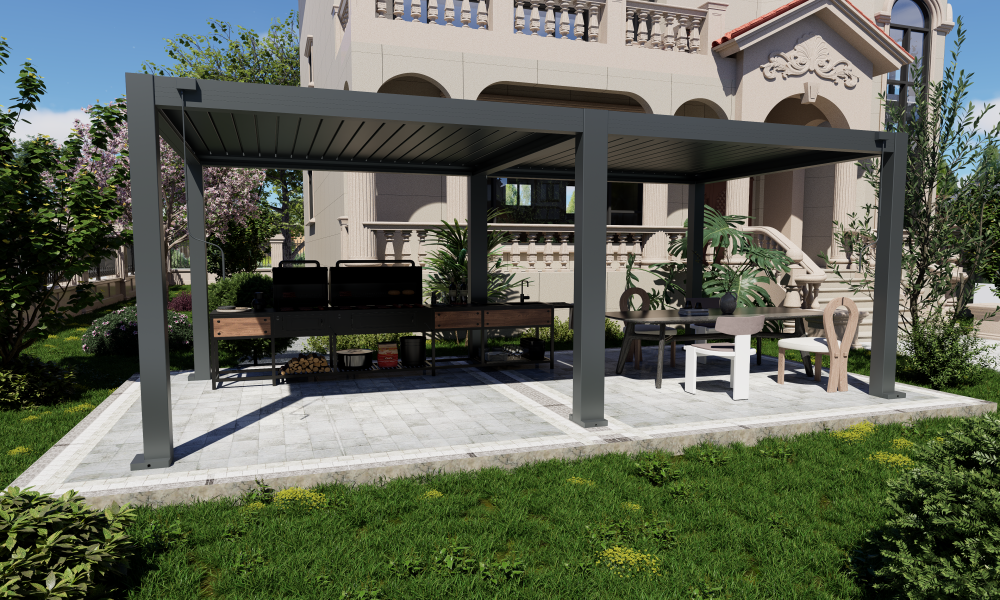
A pergola with roof usually starts as a simple plan. The backyard needs more shade. The patio needs to feel more usable. The outdoor table needs something better than an umbrella. Then the real questions show up. Late sun gets harder than expected. Light rain keeps interrupting dinner. The space looks great in photos but still feels too exposed, or too closed in, once people actually start using it.
The better question is not which roof looks best on day one. It is which roof will still feel right on a normal week: a bright afternoon, a warm evening, or a quick shower just before dinner. Once the space is judged that way, the differences between open, fixed and louvered roofs become much easier to sort out.
Quick comparison: open, fixed or louvered?
| Roof type | Usually suits | Main limitation |
|---|---|---|
| Open roof | Decorative garden areas, light-use patios, spaces with natural shade | Weak protection from strong sun and rain |
| Fixed roof | Patios that need steady shelter and simple cover | Less airflow and less flexibility |
| Louvered roof | Outdoor dining, family entertaining, mixed-weather use | Higher upfront cost than simpler options |
That quick view is useful for orientation, but the better answer usually comes from how the space actually behaves across a normal week.
A simple way to narrow the choice
The easiest way to narrow roof types is to work in this order: sun, rain, airflow, then budget. The point is not to score every option like a checklist. It is to rule things in or out quickly based on how the space is actually used.
Start with sun. If late western sun is the main problem, especially on a patio that becomes harsh after 2 pm, anything too open usually becomes frustrating quite quickly. That is often where open roofs start to fall away for a main-use outdoor area, even if they still look appealing in theory.
Then look at rain. If the space keeps getting interrupted by light showers, and the routine is always the same — move cushions, wipe chairs, pause dinner, wait it out — the roof has to do more than look good. A fixed roof may be enough when the main goal is simple cover. A louvered roof becomes more attractive when the same area is supposed to feel open in good weather and stay usable when conditions change halfway through using it.
Next comes airflow. If the patio already feels boxed in, such as a small area beside the house, near fencing, or close to brickwork that holds warmth, ventilation cannot be treated as an extra. More shade will not always solve the real problem. In these spots, a fixed roof may reduce glare while still leaving the space heavy underneath.
Only after that does budget start to mean something. By then, the brief is clearer. A decorative side area used occasionally can justify a simpler roof. A main outdoor dining zone, used several times a week with furniture left outside for most of the season, usually deserves something that can handle more than one condition well.
By that point, the wrong options usually start to rule themselves out. If the space mainly needs structure and light cover, open may still be enough. If it needs steady shelter and not much adjustment, fixed remains a strong option. If it has to handle glare, changing weather and regular use in the same week, louvered usually comes through as the more convincing answer.
Why roof choice matters more in Australia
Australian outdoor areas often ask more from a roof than people expect. A west-facing patio can feel fine in the morning and become uncomfortable by mid-afternoon. A wall-mounted pergola beside brick or rendered walls can hold warmth later into the day. A freestanding pergola in the open usually gets better airflow, but it also takes more direct weather from all sides.
Morning sun and afternoon sun do not create the same problem. A small patio used for coffee might need only light cover. The main outdoor dining area, where people sit through lunch and into the evening, usually needs more control. Position matters as well. A pergola near a boundary wall may need better airflow. A roof over open paving may need better rain handling and cleaner runoff.
That is why many Australian homes end up needing a roof that can handle glare, light rain and ventilation at the same time. Everpergo’s public range is built around all-aluminium louvered pergolas designed for Australian conditions, with wall-mounted or freestanding layouts and manual or motorised options depending on model.

What buyers should actually compare
Most buyers do not need a long technical breakdown first. They need to know whether the space will feel right to sit in. Most buyers end up judging the roof on five things: shade, rain cover, airflow, maintenance and whether the budget matches how often the space will really be used.
Shade should feel useful, not just present
An open roof can be attractive in the right setting. It keeps the structure light and works well in a garden corner that already gets filtered shade. Once the pergola is expected to deal with serious summer sun, that airy quality becomes less helpful.
A fixed roof handles shade more directly. The area below stays covered, which helps with dining tables, lounge furniture and general comfort. The trade-off is consistency. The same roof gives the same result all day. On softer mornings or in cooler weather, the space can end up darker than it needs to be.
A louvered roof usually feels easier to live with because it can respond to the way the day changes. It can open when the day is mild, tilt when glare becomes the issue, and close when stronger cover is needed. The difference shows up fast in real use. A table that feels pleasant at 11 am can be in full glare by mid-afternoon, even though the pergola still looks fine from the lawn.
Rain cover is only half the story
Rain tends to change how roofs get judged. An open roof offers very little cover once the weather turns. A fixed roof is more dependable, which is why it still suits some patios and barbecue spots.
The more useful question is what the space feels like after the rain starts. Cover matters, but runoff matters as well. Once the roof closes, water still has to move away cleanly. If it drains awkwardly or lands across the main walking path, the space still becomes annoying to use.
A louvered pergola works better here because it can close when the shower arrives, then reopen so the area feels lighter and dries out faster. That difference matters when the goal is not only staying dry, but being able to keep using the space after the weather shifts. Everpergo’s public product pages describe adjustable louvres that can open for airflow or close for shade and rain protection, with a watertight closure concept for outdoor use.
Airflow can decide whether people stay outside
This is one of the easiest parts of the decision to underestimate. A roof can look sharp from the garden and still feel stale underneath. Open roofs are naturally better for ventilation, but they leave too much exposed for many homes. Fixed roofs provide more cover, though in tighter courtyards or beside warm walls they can hold heat longer than expected.
A louvered roof gives the space some movement. Even a partial opening can help warm air escape. That matters on ordinary summer afternoons when the goal is simply to keep the space comfortable enough to sit, eat and stay outside longer.
Maintenance should stay manageable
Outdoor structures always need upkeep. The more useful question is where the mess ends up. Leaves on the roof are one thing. Leaves on the dining table just before guests arrive feel very different.
Open roofs let more debris fall straight into the living area below. Fixed roofs protect the furniture better, though they can keep dirt and moisture on top. A louvered aluminium pergola often ends up as the more workable middle ground. The area underneath stays more protected, but the roof can still open when drying and airflow matter more. Everpergo publicly positions its pergolas as all-aluminium systems intended for minimal-maintenance outdoor use.
Budget only makes sense once the role of the space is clear
Price matters, but it can be misleading if it comes in too early. A side patio used once in a while can justify a simpler roof. The main outdoor dining area, where people expect to sit through lunch, late sun and the odd shower, usually deserves more flexibility.
That is usually the point where a louvered roof starts to look less like an upgrade and more like the practical answer. It is not always the lowest upfront spend. It is often the roof people stop second-guessing once the space starts getting used properly.
Typical home situations: which one sounds most familiar?
This is usually the point where people start recognising their own backyard in the comparison.
If the space is a west-facing patio that gets harsh after 2 pm, and that late glare is the main reason nobody wants to sit there for long, an open roof usually drops down the list quite quickly. The structure may still look light and elegant, but if it cannot deal with the hardest part of the day, it is probably the wrong roof for that spot.
If the space is a small patio beside the house that traps heat, the first instinct is often to add more shade. That may help, but it may not solve the main issue. In that kind of setup, a fully fixed roof can soften the light while still leaving the area heavy and warm underneath. That is the point where airflow becomes the deciding factor, and where louvres often start to look more convincing.
If the space is the main outdoor dining zone used multiple times a week, the brief changes again. This is the area where weekday dinners happen, furniture stays in place, and people want the setup to keep working without constant fuss. Once the roof has to deal with lunch, late sun and a passing shower in the same week, a louvered option usually starts to justify itself quite clearly.
If the area is more of a secondary garden space, used occasionally rather than constantly, a simpler roof can still be the right answer. A decorative sitting corner or walkway pergola does not need the same level of control as the main entertaining zone. That is where open roofs still have a place, because nobody is depending on them for regular meals or longer afternoons outside.
If the biggest complaint is that the weather keeps changing halfway through using the space, the most static options usually become harder to justify. A roof that only works when conditions stay predictable may still look fine. It just becomes tiring to live with.
Common mistakes buyers make when choosing a pergola roof
One common mistake is choosing by appearance before checking what the afternoon sun actually does. A roof can look perfect in a product image and still leave the dining table in glare every day after lunch. Once that happens, the visual appeal tends to matter a lot less.
Another is measuring only the slab and assuming the job is done. On paper, the pergola fits. In real life, the chairs scrape the posts, circulation around the table feels cramped, and the space never quite settles. Outdoor rooms need room around the furniture, not just room above it.
A third mistake is focusing on upfront price before deciding how often the space will be used. That usually leads to a roof being judged as an object rather than as part of daily living. The answer changes a lot once the question becomes whether the area is used once a month or four or five times a week.
The last one usually appears after the first decent rain. Buyers often think rain cover is only about staying dry. It is also about runoff, where the water lands, and whether the space still feels usable afterwards. A roof that keeps the chairs dry but sends water through the main walking path has not solved the whole problem.
Which roof type suits which outdoor space?
An open roof usually suits light-use areas. Think of a garden walkway, a transition zone, or a decorative seating corner where the structure adds shape more than protection. It works best when nobody is relying on that space for regular meals, long sitting times or quick weather changes.
A fixed roof suits spaces that need straightforward shelter. A narrow patio beside the house. A barbecue spot that mostly needs cover. A place where the main question is simply whether it can stay shaded and dry, rather than whether it needs to adapt through the day.
A louvered roof suits the broad middle. Family dining areas. Outdoor lounges. Poolside seating. Decks used across different seasons. These are usually the spaces where people want flexibility: weekday dinners outside, weekend lunches that run long, furniture staying in place, and a setup that still works when conditions shift halfway through using it.

Which Everpergo setup suits which home?
The easiest way to choose between Everpergo’s core models is to think about span, frequency of use and how central the outdoor area is to the home. A pergola over a small side patio has different demands from the main entertaining zone at the back of the house.
P120: for smaller patios and simpler briefs
P120 makes sense when the area is smaller, the budget is more cautious, and the pergola does not need to define the whole backyard. A compact courtyard or light-use patio is usually where this kind of setup feels most natural. It is the better fit when the pergola is supporting the outdoor area rather than becoming the main feature. Everpergo’s compare page positions P120 as the more budget-friendly entry in the range.
P180: the easiest all-round choice for most homes
P180 is the model that feels easiest to recommend across a typical family backyard. It suits the most common brief well: a roof that feels substantial enough for everyday use without becoming too heavy for a normal residential space. For many homes, this is the option that makes the shortlist easiest. Everpergo presents P180 as a balanced choice across strength, appearance and everyday usability.
P180 Pro: for larger entertaining areas
P180 Pro makes more sense when the outdoor area is larger and the roof needs stronger visual presence as well as wider coverage. It suits broad entertaining zones, bigger decks and more ambitious backyard layouts. In those settings, a lighter-looking roof can feel underdone, even if it technically covers the space. Everpergo positions P180 Pro as the stronger fit for larger spans and more premium projects.
For a closer look at the differences, it helps to see how the P120, P180 and P180 Pro compare ,If the goal is to browse the overall range first, the full pergola collection is here.

What to decide before ordering
Once the roof type feels clear, the simplest way to keep the project from getting overcomplicated is to settle these in order: footprint first, layout second, control third, drainage fourth.
Start with the footprint. Do not just measure the slab and stop there. Measure the slab, then picture the chairs pulled out, people moving around the table, and the space being used on a normal evening. If the pergola only fits the hard surface and not the way the furniture actually works, it will feel tight from the start.
Then choose the layout. A wall-mounted pergola usually makes more sense when the goal is to extend the home directly into the backyard. A freestanding pergola works better when the structure is creating a separate outdoor room, perhaps near a pool or deeper in the garden. If the area already feels enclosed, that should stay part of the layout decision.
After that, decide on control. Manual operation can still be the right answer for smaller pergolas or spaces that are not adjusted constantly. Motorised control starts to make more sense when the roof is larger or likely to be opened and closed several times in one day. A simple test helps here: if the roof needs frequent adjustment for the space to feel right, ease of control matters more.
Finally, settle drainage before the order is locked in. Once the roof closes in rain, the water path matters. Downpipe direction, slab fall and surrounding paving all affect what the space feels like afterwards. A well-designed roof can still feel awkward if runoff ends up where people walk or where furniture sits.
For projects moving past the comparison stage, the next useful step is to customise the pergola size, layout and roof control .Everpergo’s public information also notes custom sizing, wall-mounted or freestanding configurations, and manual or motorised options depending on the model.
A quick check before placing the order
Before locking anything in, it helps to run through a short check:
-
Where is the strongest sun: morning or afternoon?
-
Will people eat outside here regularly, or only occasionally?
-
Does the furniture stay out most of the time?
-
Is the space close to a wall that may trap warmth?
-
When it rains, is the bigger problem getting wet, or staying usable afterwards?
-
Is this pergola supporting the backyard, or defining the main outdoor living zone?
If most answers point toward frequent use, changing weather, late sun and furniture staying in place, a louvered roof usually becomes much easier to justify.
Installation and support
Everpergo’s public information suggests that installation support can include guides, technical assistance and recommended installers, depending on the project. The important point for buyers is to clarify the installation pathway early rather than assume it will sort itself out later. Everpergo also publicly notes a Dandenong, Melbourne showroom and warehouse, nationwide delivery, a 10-year structural warranty and a 2-year motorised warranty.
FAQ
What type of pergola roof is best for a west-facing patio?
If the main problem is strong afternoon sun, an open roof usually becomes harder to justify for a main-use space. Fixed roofs can work if steady shade is the main goal. A louvered roof is often the better fit when the same patio also needs airflow and flexibility through the day.
Is a fixed pergola roof enough for a small patio beside the house?
It can be, especially if the main job is simply to keep the area shaded and dry. If that same patio already feels enclosed or tends to trap heat, a fixed roof may not solve the whole problem. That is where airflow starts to matter more, and where louvres can make a noticeable difference.
When is a louvered roof really worth paying more for?
Usually when the space is used often and expected to handle more than one condition well. If the area needs shade at lunch, comfort on warm afternoons, and cover during light rain without moving furniture all the time, the extra flexibility becomes much easier to justify.
Is an open roof still a good option for any outdoor space?
Yes. Open roofs still suit decorative garden areas, walkways and lighter-use spaces where nobody is depending on the roof for regular meals, longer sitting times or fast weather changes.
Can Everpergo pergolas be customised?
Yes. Everpergo’s public customisation page says width, depth and height can be tailored, with wall-mounted or freestanding layouts and manual or motorised options depending on model.
Does Everpergo install pergolas directly?
Everpergo’s public information indicates that direct installation is not the main model, but guides, technical support and recommended installers may be available depending on the project.
Final thought
The best roof is usually the one that matches the way the space is actually used. If the area needs to work through lunch, late sun, light rain and regular everyday use, an adjustable roof often becomes easier to live with over time.
From there, the decision becomes less about roof types and more about getting the size, layout and control option right for the space. That is usually the point where Everpergo’s custom pergola page becomes genuinely useful.


Share:
Wall-Mounted or Freestanding: Aluminium Louvre Pergolas Adapt to Australia's Diverse Outdoor Layouts
Louvered Pergola Cost in Australia: What Affects the Price?