

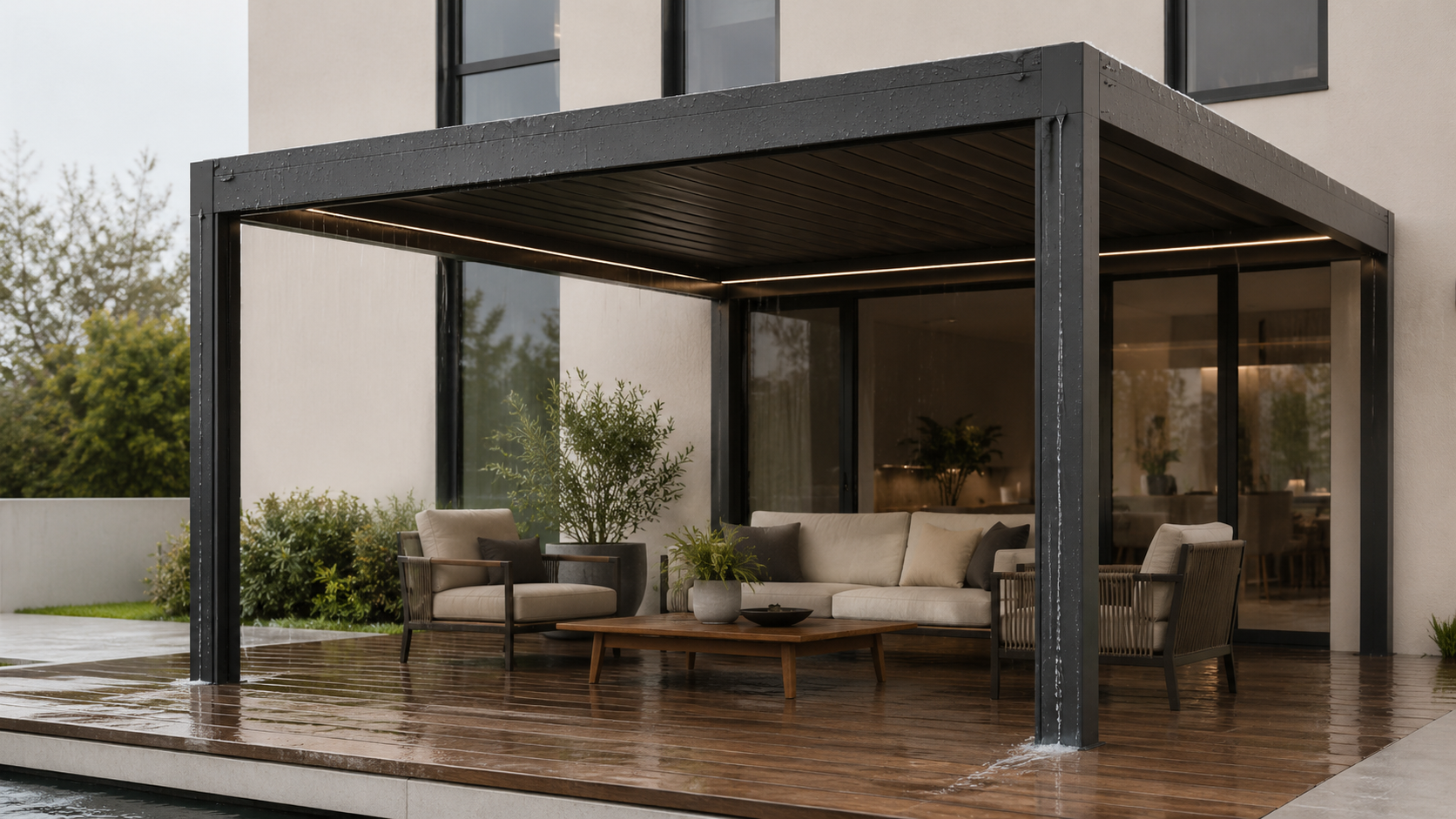
A louvered pergola earns trust when rain arrives, not only when the patio looks perfect in the sun. The useful question is simple: where does the water go after it lands on the roof? If the answer is clear, the outdoor table, walkway and seating area feel calmer after a shower. If the answer is vague, even a good-looking patio can feel awkward.
Why Choose a Louvered Pergola for Rainwater Control
The main reason is control. A fixed open pergola gives shade structure, but rain falls through. A solid roof gives cover, but it can make the patio feel darker and more closed. A louvred roof sits between those two choices. It can open for light and airflow, then close when the weather turns.
For drainage, the value is not only that the roof closes. The value is that rain has a planned path. Water lands on the closed blades, moves toward channels, and should leave the structure away from the main sitting area. That makes the patio feel more usable after light rain and more predictable during wet weather.
This matters most in everyday moments: coffee tables that do not need moving at the first grey cloud, dining chairs that stay away from drip lines, and walkways that still feel sensible after a 20-minute shower.
Simple takeaway
Choose this style when the patio needs shade, airflow and better rain control in one structure, rather than a roof that only works well in one season.
 View P180 Louvered Pergola
 Best Scenarios for Louvered Pergola Drainage
This type of roof works especially well where the outdoor area is used often, not just decorated. Dining patios, garden lounges, BBQ corners, poolside sitting zones and wall-side terraces all benefit from a roof that can adjust with the weather.
A small patio needs the most careful planning. There may only be one natural walking line from the kitchen to the table. If water exits across that line, the space feels smaller after every shower. For this kind of area, post placement and drainage direction matter as much as the roof size.
A larger backyard has a different issue. The roof can cover more furniture, but it also collects more rain. That makes the water exit path more important, especially near paving edges, pool areas, garden beds or steps.
Wall-mounted patios need extra thought around the house side. Existing gutters, downpipes, eaves, door clearance and paving fall should all be checked before the final layout is settled.
Dining patios
Best when chairs, table legs and walking space need to stay more comfortable after rain.
Poolside areas
Useful where shade, glare control and water movement all affect daily comfort.
Wall-side spaces
Good for patios connected to kitchens or living rooms, if drainage near the house is planned early.
How Rainwater Is Managed Through Louvres and Channels
The drainage idea is simple. When the louvres close, the roof forms a controlled surface. Rain runs across the blades, reaches the channels, and then moves toward the frame or post area. The aim is to guide water away from the middle of the patio.
The important detail is the full route. It is not enough for the roof to catch rain. Water still needs to leave the structure in a sensible place. A garden edge may work well. A doorway, step or chair position usually does not.
The best planning question is not only “Does the roof help with overhead rain?” It is: “Where does the water go after it reaches the roof?” That question quickly reveals whether the layout is practical.
1. Close
The louvres close to reduce direct overhead rain through the roof area.
2. Channel
Water moves toward the roof edges and drainage channels.
3. Release
The final exit point should avoid seating, doors and main walkways.
How to Decide Whether This Pergola Is Worth Buying
The decision should start with how the patio is used. If the space is only decorative, drainage may not feel urgent. If the area is used for meals, coffee, BBQs, family time or poolside sitting, rainwater control becomes much more important.
A louvered pergola is usually worth considering when the patio needs to work across more than one weather condition. It should provide shade on bright days, airflow when the roof is open, and better overhead rain management when the roof is closed.
It may not be the best answer if the area has serious ground drainage problems that already leave standing water after rain. In that case, the ground issue should be checked first. A pergola can manage rain from above, but it cannot fix a patio surface that drains badly by itself.
Before choosing a final size or post position, check local council or state requirements. Roofed outdoor structures may need to manage roof water through an existing stormwater system, and approval rules can vary by site, state, council area, attachment method and structure size.
Quick decision check
- The patio is used at least a few times each week.
- Rain currently limits outdoor meals or seating.
- The roof needs to open for airflow, not stay closed all year.
- There is a clear place for water to leave the structure.
- Post positions can avoid chairs, steps, doors and main walkways.
Not sure where the water should go?
A few patio photos, rough dimensions and one photo after rain can make the drainage discussion much clearer before choosing a final size.
P180 or P180 Pro: Which Layout Makes More Sense?
The P180 Louvered Pergola is a practical starting point for many everyday patios. It suits dining corners, lounge areas, garden-facing spaces and wall-side layouts where shade, airflow and rain control all need to work together.
The P180 Pro makes more sense for wider outdoor areas that need stronger visual presence and broader coverage. Larger roofs collect more rain, so post placement and water exit planning become even more important.
For irregular patios, a custom layout may be the better direction. A narrow side area, low eave, existing outdoor kitchen, offset paving line or awkward drain can all make standard sizing feel less natural.
 Explore P180 Pro
 Choose P180 when
The patio needs balanced shade, airflow and daily rain control without feeling too heavy.
Choose P180 Pro when
The outdoor area is wider, more exposed, or needs a stronger architectural frame.
Consider custom when
Posts, doors, drainage, paving or furniture need a more exact fit.
Common Mistakes When Planning Pergola Drainage
The first mistake is choosing the largest roof without checking where water will leave it. More cover can be useful, but more roof area also collects more rain. A bigger roof with a poor exit point can create a bigger problem.
The second mistake is ignoring the patio after rain. Dry paving hides a lot. Wet paving shows low points, slow-drying corners, splash zones and the direction water already wants to travel.
The third mistake is placing posts for symmetry only. A post can look balanced in a drawing and still block a chair, crowd a barbecue or interrupt the route from the back door.
The fourth mistake is expecting accessories to fix a poor layout. Wind blinds, lighting and side features can improve comfort, but they should support a good plan rather than rescue a bad water path.
Accessories can help with side exposure, low sun and wind-driven rain. However, they should not replace the main drainage plan. The roof direction, channel route and final water exit point still need to make sense first.
 View Pergola Accessories
 Approval and Stormwater Checks Before You Finalise the Layout
Drainage planning is not only a comfort issue. It can also affect approval, installation and long-term site performance. A roofed pergola may need a clear stormwater path, especially when it is attached to the home or sits close to existing gutters, downpipes, paving falls or garden drainage.
For example, NSW Planning guidance for balconies, decks, patios, pergolas, terraces and verandahs notes that roof water for roofed structures may need to be disposed of into an existing stormwater drainage system, and the structure must not interfere with existing drainage fixtures or flow paths. Requirements can vary outside NSW, so homeowners should check local council or state guidance before confirming a final plan.
This is why a real patio review helps. Photos after rain can show where the ground already drains, where water slows down, and where a new roof exit point should not be placed. If the wettest corner is already beside the back door, that area should not become the main release point.
What to check before confirming the order
- Existing gutters, downpipes and drainage points.
- The direction paving or decking already falls after rain.
- Whether a wall-mounted structure may need local approval.
- Whether the release point avoids doors, steps, seating and walkways.
- Whether the final plan follows local council or state requirements.
Extended Reading
These pages help connect drainage planning with model choice, roof type and custom sizing.
FAQ: Louvered Pergola Drainage
Does a closed louvred roof stop all rain?
A closed louvred roof helps manage overhead rain and guide water toward the drainage path. However, wind-driven rain, splash, heavy storms and blocked channels can still affect open outdoor spaces.
What makes louvered pergola drainage work well?
Good drainage depends on roof closure, channels, roof direction, post location and the surface below. Water should leave the structure away from seating, doors, steps and main walkways.
Should drainage be planned before choosing the final pergola size?
Yes. Size affects water volume and post positions. A larger roof can provide more coverage, but it also collects more rain, so the water exit path should be clear before finalising the layout.
Do approval rules affect pergola drainage?
They can. Requirements vary by state, council area, structure size, attachment method and site condition. A roofed structure may need a suitable stormwater path, so homeowners should check local requirements before finalising the layout.
Does Everpergo directly provide installation services?
Everpergo does not directly provide installation services, but can recommend experienced installers and provide installation guides and technical support. Site preparation and drainage planning should be clarified before work begins.
How often should channels and roof edges be checked?
A simple seasonal check is sensible, with extra attention after windy weather or heavy rain. Leaves, twigs and small debris should not sit in drainage areas for long periods.
Final Thoughts: Plan the Water Before Choosing the Roof
A well-planned pergola should not only look good in the sun. It should also make the patio feel calmer when the weather changes. The strongest result comes from a simple order: check the rain path, mark the furniture, then choose the roof size and post positions.
For a practical starting point, the P180 suits many everyday patios where shade, airflow and drainage all need to work together. For larger or more exposed areas, P180 Pro may be the better direction. For awkward sites, custom sizing often creates the cleanest result.
- Check the patio after real rain before locking in the layout.
- Keep posts away from chairs, steps, doors and main walking lines.
- Confirm whether local approval or stormwater rules affect the plan.
- Choose the model around real use, not only around the largest possible roof size.
Need to check a real drainage condition?
Patio photos, rough dimensions, wall height, paving fall and the wettest corner can help clarify whether P180, P180 Pro or a custom layout makes more sense.
Share:
Pergola Height Guide for Comfortable Outdoor Living
Roofed Pergola vs Shade Sail: Which Works Better Long Term?