

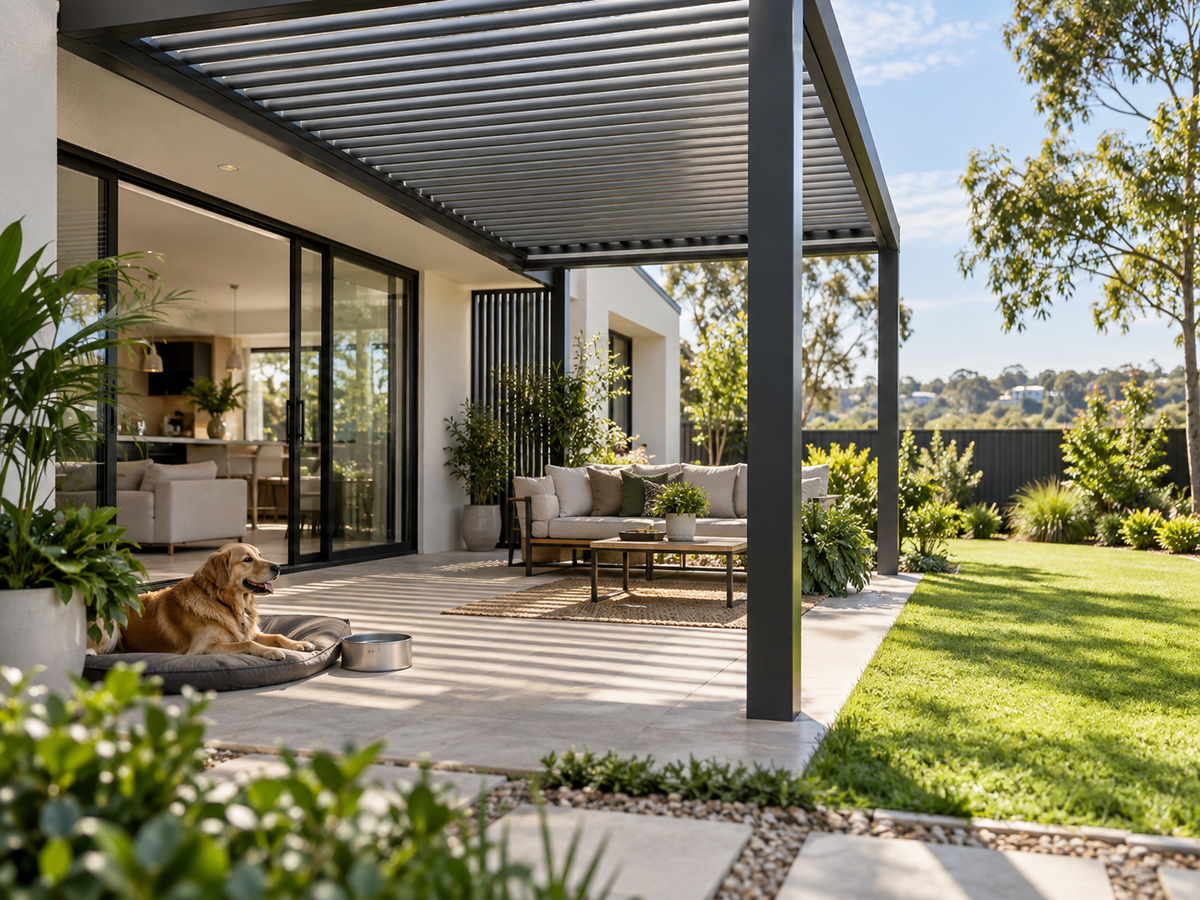
Planning a pergola for a dog-friendly backyard works best when the layout follows the dog’s actual routine rather than an empty patch of paving. The useful questions are practical: where does the dog naturally settle, when does that spot receive useful shade, can air still move through the resting zone, where can water stay accessible, and does the normal route between the house and yard remain clear?
An outdoor pergola can help create a more usable covered resting area, but overhead cover should not be treated as a guarantee that outdoor conditions are always suitable. Sun angle changes through the day, side exposure still matters, and every dog has different needs. The better approach is to observe the space first, then position the roof, water and circulation around what actually happens there.
The practical test
A useful setup should make four things easier at the same time: resting in shade, reaching water, getting some air movement and moving between indoors and the yard without repeatedly negotiating posts, bowls or furniture. If improving one of those makes another noticeably worse, the layout needs another look.
What should a dog-friendly shaded area make easier?
Start with what the dog already does. In many backyards, the preferred resting spot is not the geometrical centre of the patio. It may be just outside the back door, beside a wall, near the lawn edge or somewhere with a clear view across the garden. If a pergola covers a technically convenient corner but the dog consistently chooses somewhere else, the roof has solved the wrong problem.
Watch the routine on an ordinary day. Where does the dog settle after coming outside? Where is the water approached from? Which direction does the dog take back towards the door? Does the resting position change as sunlight moves across the paving? Those repeated behaviours give the design a much stronger starting point than simply asking how much of the backyard can be roofed.
These needs should overlap without collapsing into one crowded zone. A dog bed does not need to sit on top of the water bowl. The bowl does not need to occupy the doorway just because that part of the patio is covered. The pergola itself does not need to become an enclosure. A good result feels easy because each part of the routine has enough room to function.
Check where the resting shade falls through the day
Roof area and useful shade are not the same thing. The sun changes direction and angle, so the patch of floor protected at one point in the day may be partly exposed later. This matters more when a dog repeatedly chooses one specific edge of the patio rather than moving wherever the deepest shade happens to be.
Instead of assessing the yard once, look at the intended resting zone at the times it is normally used. A backyard used mostly before work may behave very differently from one used during a long afternoon at home. The purpose is not to calculate a theoretical shade percentage. It is to see whether direct sun reaches the actual resting position during the period that position matters.
Notice whether the preferred resting point receives useful shade or whether the dog naturally chooses a different edge of the yard.
Look at the floor, not just the roof. Paving can remain hot even after it moves into shade, and side light or reflected heat can affect the resting spot. Check the surface before the dog uses it.
Low sun can enter beneath the roof edge. Check whether the dog shifts position as that happens and where it chooses to go instead.
A simple observation can reveal more than a polished plan. Place the dog’s usual mat or resting bed where it normally sits, then look at the floor around it as the day changes. If half of that position becomes exposed, note the direction the light enters from. If the dog consistently leaves the covered area for another patch of shade, that is useful information as well.
Do not turn the observation into a heat guarantee.
The design question is whether the roof provides useful shade at the dog’s normal resting location. It should not be used to claim that a shaded outdoor area is automatically appropriate in every weather condition or for prolonged unsupervised use.
Keep air moving around the resting area
Shade can improve a resting zone without making it feel open. A sofa across one side, a storage box against another and a privacy screen on the third can turn a roofed corner into a much more enclosed space than the drawing suggests. Because dogs rest close to floor level, it is worth looking at what blocks the lower part of the space rather than judging airflow only while standing.
Stand near the intended resting point and look outward. Is there a reasonably open path towards the lawn or side yard? Does a large piece of furniture sit directly between that spot and the open edge? Would a planter, storage chest or rolled-down screen close a gap that currently allows the space to breathe?
The useful question is not “How many sides are open?” It is “What will actually sit between the resting spot and those open sides during normal use?”
That distinction prevents a common layout mistake. A technically open pergola can still feel boxed in once outdoor furniture, a barbecue, storage and screening are added. On the other hand, a compact space can remain visually and physically open when bulky items are kept away from the resting edge.
An adjustable louvred roof can change the balance between overhead cover and openness above, but roof movement cannot compensate for every obstruction around the sides. If the space already has high fences, dense planting or a close house wall, keep the remaining open edges useful rather than filling them automatically.
This is also where restraint helps. The dog-friendly solution is not necessarily another “pet” accessory. If an item has no verified role in the pergola system or no clear benefit to the actual resting route, it does not need to be introduced simply because the yard includes a dog.
Place water and preserve clear movement paths
Water and circulation often compete for the same convenient area close to the back door. That makes this part of the plan deceptively important. The bowl needs to be accessible, but it should not become something that people, paws or a lead repeatedly have to negotiate.
The place the dog naturally chooses to settle should remain usable when chairs, doors and other everyday objects are in their normal positions.
The route between the door, bowl, resting point and yard should remain obvious rather than weaving around posts or movable furniture.
Keep the water bowl near the resting area, not inside the traffic line
“Under the pergola” is not precise enough as a water location. Put the bowl somewhere that is easy to reach from the resting position but does not sit directly in the route from the house to the lawn. This usually becomes clear only when the outdoor area is set up as it will be used.
Pull out the chairs. Open the back door. Put the dog bed or mat in place. Then set the water bowl where you are considering it. Walk from the house to the yard several times. If the bowl repeatedly makes someone alter their step, or if the dog needs to squeeze between furniture to reach it, the location looks more convenient on paper than it is in daily use.
Also observe the bowl location separately from the resting mat. A roof edge that shades the bed at one time of day may leave the water point exposed as the sun moves. This is another reason to assess the two positions individually rather than assuming everything inside the pergola footprint behaves the same way.
Protect the repeated route between the house and yard
Most dogs develop repeatable paths. The important route might be from a sliding door straight to the lawn, from the resting mat to the water bowl, or from a side passage back to the house. Draw those lines mentally before fixing the pergola position.
Post placement deserves particular attention close to doorways and corners. A post that looks unobtrusive when viewed from the lawn may become awkward if dog and handler naturally turn around it every time they step outside. If a lead is routinely used, think about its sweep as the dog changes direction rather than assessing only the width of a person walking straight through.
A quick route test before choosing the final position
Stand at the usual indoor exit and walk the dog’s normal route with the furniture where it belongs.
Pause where a pergola post is likely to sit and check whether that point falls into a natural turn or lead path.
Repeat the route from the resting spot to the water and back indoors. The path should still make sense without rearranging the patio.
A pergola does not need to change how the whole backyard works. It should provide useful cover without making the dog’s familiar routes harder to follow.
Translate the observations into pergola questions
Once the resting spot, sun movement, water point and repeated routes are visible, the pergola conversation becomes much more useful. Instead of beginning with a model name, start with the conditions the structure needs to work around.
A short site note might say that the dog normally rests near the house-side edge of the deck, the later-afternoon sun enters from one side, the water needs to sit clear of the doorway and the direct line to the lawn cannot be narrowed. That gives the roof position and post layout a reason. It also makes it easier to reject a footprint that looks neat but creates daily friction.


P120 shown in compact outdoor settings. The relevant check for this article is whether a smaller pergola footprint can cover the intended resting area without interfering with the route to the lawn or house.
view the P120 optionUse the compact model as a size question, not a pet claim
A compact rest zone may justify checking a smaller pergola such as P120, particularly when the most important requirement is to cover one useful part of the patio while keeping surrounding movement open. That does not make the model automatically suitable for every dog-friendly backyard.
Site conditions, the intended pergola position and the actual circulation pattern still decide whether the footprint works. If the structure would push a post into the dog’s normal route simply to gain more roof coverage, a different position or configuration deserves consideration.
Treat the P120 as a pergola, not a pet enclosure or kennel substitute. Its aluminium structure should not be assumed to be chew-proof or escape-proof. The aim is to plan useful shade, open space and clear routes around the dog’s resting area.
The same discipline applies when comparing the broader range. Do not start with the largest frame that fits the paving and then try to force the dog’s routine around it. Start with the small number of areas that must remain useful, then see which footprint can accommodate them with the least compromise.
When those notes are ready, use them to explore EVERPERGO outdoor living and then compare the pergola collection . The useful comparison is not “Which pergola is best for dogs?” but “Which layout can cover the intended rest zone while leaving water access and the normal movement line uncomplicated?”
Before comparing models
Take three notes into the decision: where the dog rests, where the water should stay, and which route cannot be blocked.
Add a simple observation of where direct sun reaches the resting area and which edges need to remain open. That is enough to turn a vague “pet-friendly pergola” enquiry into a site-specific discussion without pretending the pergola itself provides pet supervision or heat protection.
FAQs about a pergola for a dog-friendly backyard
These questions focus on the everyday limits of a covered pet resting area rather than treating the pergola as a pet-safety system.
Does overhead cover guarantee shade in the same spot all day?
No. Shade changes as the sun moves, and direct light can enter from the sides even when a roof sits above the area. Check the dog’s actual resting spot during the periods it is normally used rather than assuming the entire pergola footprint remains equally shaded throughout the day.
Where should water sit relative to the resting space and main route?
Keep the bowl easy to reach from the resting area but outside the main path between the house and yard. Test the position with normal furniture in place. If people or the dog repeatedly need to step around the bowl, move it away from the traffic line while keeping it convenient.
Can enclosing more sides reduce airflow?
Greater enclosure can reduce the available paths for air to move through a resting area, depending on the site and surrounding conditions. Furniture, storage, planting and screens can matter as much as the pergola itself, so assess the finished occupied space rather than counting open sides in an empty plan.
Does a pergola replace supervision or access to a suitable indoor space?
No. A pergola creates an outdoor covered zone; it does not replace supervision, access to an appropriate indoor area or attention to the needs of the individual dog. The layout should make ordinary outdoor use easier without being treated as a guarantee that the dog can remain outside in every condition.
Share:
Pergola for an Outdoor Home Office: Glare, Screen Visibility and Daytime Airflow
Visiting a Pergola Showroom: What to Test Before Choosing P120, P180 or P180 Pro