

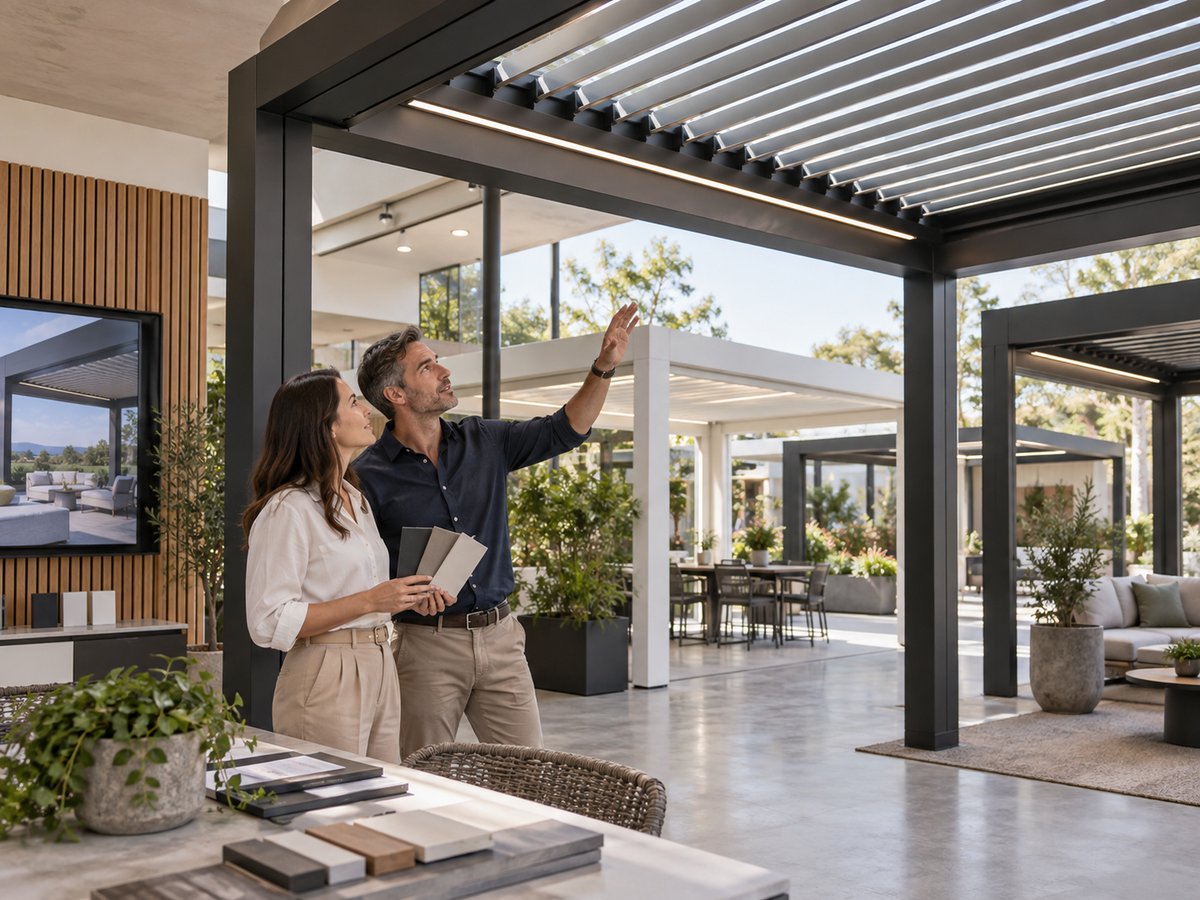
A pergola showroom visit is most useful for judging the things a product page cannot fully communicate: how the louvres move, how substantial the frame feels at standing distance, how the roof changes when it opens and closes, and how a physical colour finish looks under real light.
Before travelling, confirm which P120, P180 or P180 Pro displays are currently available and whether staff can demonstrate the configuration you want to see. Once there, focus on what can genuinely be observed in person.
The useful showroom rule
Observe first, identify the display second, compare official information afterwards. A full-size pergola can tell you a great deal about proportion, movement and colour, but only if you know exactly which model and configuration you are looking at.
What can a showroom visit tell you that a product page cannot?
Product pages are useful for identifying models, viewing listed configurations and narrowing a shortlist. What they cannot fully reproduce is the physical relationship between a pergola and the person standing beneath it.
A beam that looks relatively slim in a wide-angle image may feel more visually present when it sits above a dining setting. A post that disappears into the edge of a photograph may become an important part of the view when you stand beside it. Likewise, an adjustable roof is easier to understand when you can watch the overhead space change rather than switching between two still photographs.
If you have already been looking at pergolas for sale, resist the temptation to turn the showroom visit into another broad buying checklist. Delivery access, final dimensions, site preparation and installation questions belong in their own planning process.
Give the showroom a narrower job: use it to resolve uncertainties that are genuinely easier to judge in person. You should leave with clearer preferences and better questions, not with the assumption that the display floor reproduces your backyard.
Watch and try the louvre operation
An adjustable roof becomes much easier to understand once it is seen moving. If staff permit visitors to operate the display, use the control yourself. If not, ask for a demonstration and watch a meaningful change in roof position rather than only a small movement.
Stand beneath the louvered pergola while the roof changes. Look upward first, then lower your eyes toward the surrounding space. The useful observation is how the entire outdoor room changes: the amount of visible sky, the apparent weight of the roof and the relationship between the overhead structure and the area beyond it.

Identify the display before judging the control experience
The control in your hand belongs to the display in front of you. That does not automatically mean every P120, P180 or P180 Pro uses the same configuration or that every option is physically represented in the showroom.
Model:
Which pergola am I actually looking at?
Configuration:
Which control setup is fitted to this display?
Alternative:
Are other configurations available for this model?
Record:
Write the answer beside the observation.
Think about frequency of use rather than searching for a universally “better” control. A roof beside a dining area might be adjusted as sunlight moves across an afternoon. Another roof may stay in a preferred position for long periods. Seeing the operation gives context to those routines without requiring this article to become a manual-versus-motorised buying guide.
The important question after the demonstration is not simply “Did I like it?” It is “Was the configuration I experienced the one I am actually considering?” If the answer is unclear, put that question on the follow-up list.
Stand beneath the frame and compare proportions
Frame proportion is one of the strongest reasons to see a pergola in person. Online photography usually shows the entire structure from a flattering distance. Daily use is different. A homeowner experiences the pergola while walking beside a post, sitting below a beam, looking outward toward the garden or looking back at the roof from inside the house.
Look at beams and posts from normal viewing distances
Start close enough to notice the finish and edge profile. Then move several steps away. Finally, stand beneath the frame where a dining chair, barbecue position or outdoor lounge might realistically sit.
This change of distance is important. A component can look visually prominent in a close-up but balanced as part of the complete structure. The reverse can also happen: a post that seemed insignificant online may become more noticeable when it sits directly in a common sightline.
Try three viewpoints
Under the roof: notice how present the beams feel above a normal standing or seating position.
Outside one corner: judge how the posts and roof read together as a complete frame.
Further away: look at the overall silhouette rather than individual components.
Do not decide that a visually stronger frame is automatically worse, or that a lighter-looking structure is automatically better. The appropriate visual weight depends on the scale and character of the outdoor area. A broad entertaining space may comfortably carry more architectural presence than a narrow courtyard.
Compare the roof profile open and closed
A pergola should not be judged only with the louvres parked in the position that happened to look best when you arrived. Where possible, view the roof in more than one position.
As the louvres open, more sky becomes visible and the overhead plane can feel visually lighter. When they close, the roof becomes a more continuous surface. That change may be especially noticeable when the pergola sits directly outside a kitchen, dining room or living area.

Keep the judgement visual. If one display looks more substantial than another, record exactly that. Do not convert appearance into assumptions about strength, performance or suitability unless the relevant official product information confirms them.
Compare real colour samples and ask what is actually on display
Colour is easy to misread on a laptop or phone. Screen brightness, photography, image processing and the colour of surrounding surfaces all influence what reaches your eye. A physical sample removes some of those variables, although it still needs to be viewed in context.
If staff allow it, move the sample between brighter and softer light. Place relevant finishes beside one another rather than judging them one at a time. Small differences in warmth or contrast are often easier to see when two finishes share the same light.
Scale also matters. A colour occupying a small hand sample can feel different when the same general finish covers posts, beams and other visible frame surfaces. Whenever possible, use the physical sample for close comparison and the complete display for overall visual impression.
Before making the trip: confirm which models, finishes and operating configurations can currently be viewed. This avoids arriving with a question that the available display cannot answer.
Turn showroom observations into a model-specific follow-up
A showroom visit becomes much more valuable when observations are attached to an exact model rather than left as general impressions. P120 has smaller listed beam and post dimensions than P180 and P180 Pro, while P180 Pro uses double-layer rather than single-layer louvres. These are useful differences to look for if the relevant displays are available. You do not need pages of notes. You need enough detail to reconstruct what you actually saw.
Start with Everpergo’s P120, P180 and P180 Pro comparison to connect what you saw in person with the official specifications. If P180 Pro is on your shortlist but was not displayed, check the P180 Pro product details rather than assuming its roof configuration matches another model.
Match your observation to P120
Return to the product page to review P120 details and check which parts of the showroom experience relate to the configuration being considered.
Explore P120Do the same check for P180
Use the official page to review P180 details instead of assuming that the particular showroom configuration represents every available choice.
Explore P180A useful note sounds like this:
“Saw this model with one control configuration. Frame proportion looked balanced from dining distance. Preferred the lighter of the two physical finishes. Need to confirm whether the configuration being considered uses the same operating setup.”
Plan the visit around what you need to see
Confirm the display first, then bring the questions the screen could not answer.
Check which models and configurations can currently be viewed or demonstrated before travelling. Bring exterior photos and a short list of unresolved questions, then compare your showroom observations with the relevant product information afterwards.
Pergola showroom visit FAQs
Will every model and configuration be on display?
Do not assume so. Confirm which models, finishes and operating configurations can currently be viewed before travelling. A showroom visit can still be useful when only selected systems are available, provided you know exactly which display you are assessing.
What should I ask before operating a display roof?
Ask whether visitors may operate that particular display, which model it is and which control configuration is fitted. Follow staff instructions around moving equipment and record the configuration so that the experience can be matched with the correct product information later.
Why should I compare physical colour samples?
A physical sample reduces some of the uncertainty created by screen settings, photography and image processing. It also allows relevant finishes to be compared under the same available light and beside photos of the materials already used around the home.
What notes should I take home after the visit?
Record the exact display model, the configuration you observed, your impression of frame proportion and roof movement, the colour samples you compared and anything that still needs confirmation. The most useful note is often the unresolved question that can be checked against the correct model information afterwards.
Share:
Pergola for a Dog-Friendly Backyard: Shade, Ventilation and Clear Movement Paths
Bioclimatic Pergola for Multi-Season Outdoor Dining in Australia