

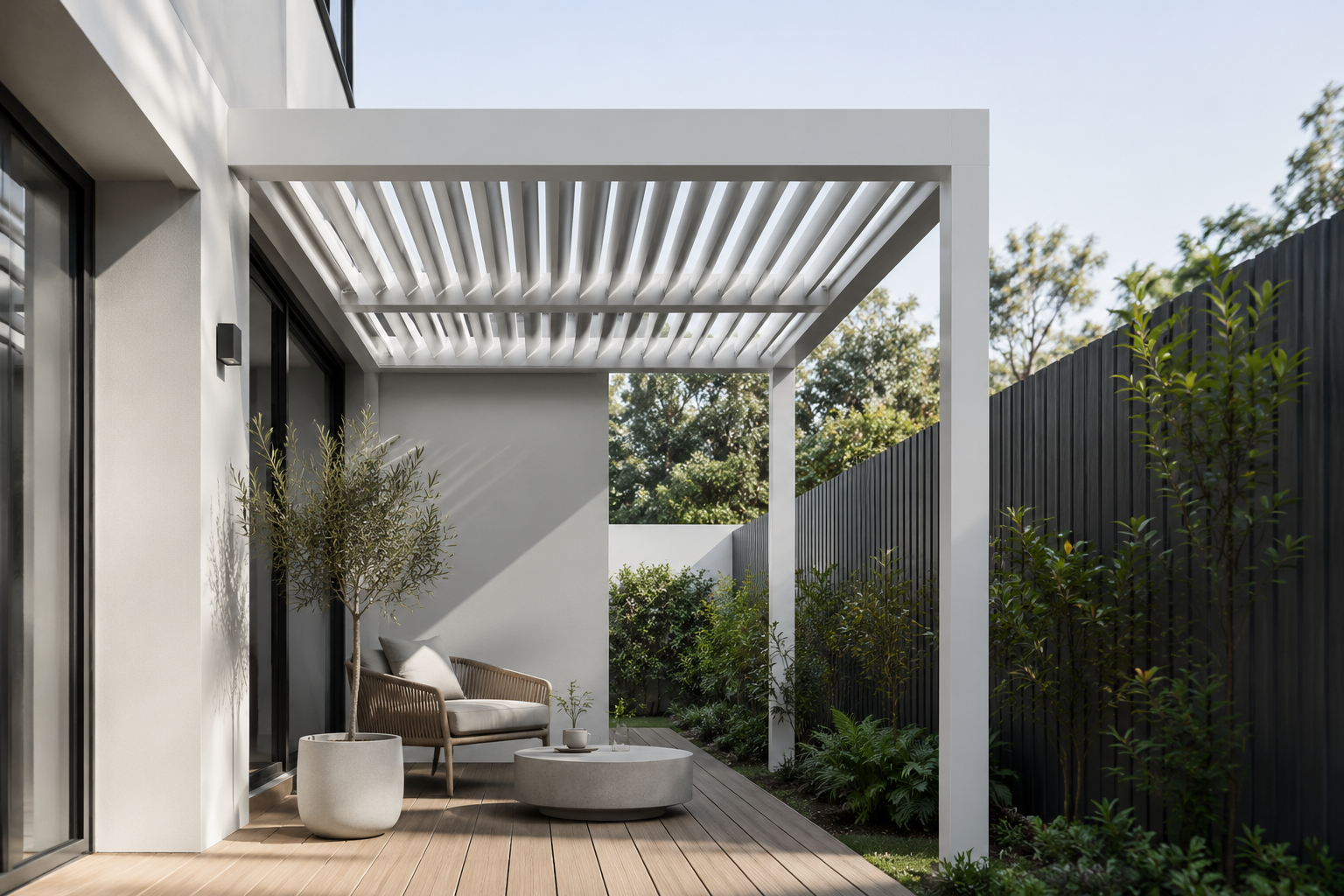
A garden pergola can turn a narrow yard from an awkward side strip into a calm outdoor room. But the layout has to be handled with care. In a long garden, one post in the wrong spot can interrupt the walking path. One heavy roof can make the view feel shorter. One overgrown plant can make the whole area feel tighter by the end of summer.
The best narrow-yard pergola does not try to cover everything. It protects the part of the garden where life actually happens: a small dining table, a morning coffee chair, a shaded reading spot, or the doorway that becomes too hot in the afternoon. This guide focuses on layout, light, planting, privacy, and sizing, with practical ways to make a slim outdoor space feel open rather than boxed in.
Before choosing a size
A narrow yard needs one strong idea, not more stuff
A slim outdoor area usually feels better when the design has one clear purpose. It may be a shaded lunch spot, a quiet reading corner, a cooler doorway, or a protected strip beside the house. Once that purpose is clear, the pergola can support the space instead of taking it over.
This is the main difference between a pergola that looks good online and one that feels good on a normal weekday. The finished space should still have a walking line, a view, a little sky, and enough room for plants to soften the edges.
Why narrow yards need a different garden pergola plan
A narrow yard behaves differently from a normal patio. It has less room to forgive mistakes. A chair pulled back forty centimetres can block the only walking line. A tall pot placed beside a post can make the side access feel cramped. A roof that looks modest on paper can feel heavy from the kitchen window because the eye has nowhere else to go.
That is why the first step is not choosing the largest roof that fits. The first step is understanding the yard at ordinary times of day. Morning light may make the space feel generous. Midday heat may make it unusable. Evening shade may make the same strip feel calm again. A good layout should respond to those changes instead of treating the yard like a flat rectangle.
In a long side yard, the strongest design usually protects one useful zone and keeps one long view open. This gives the garden a rhythm. There is a place to sit, a place to walk, and a place for plants to soften the edge. When everything is covered, screened, planted, and furnished at once, the space can lose that rhythm quickly.
A narrow garden pergola also needs to feel good from inside the home. This matters more than many layout plans admit. The pergola may be seen every morning from a dining table, sofa, or kitchen bench. If a post blocks the best view or the roof makes the room feel darker, the outdoor upgrade can start to feel like an indoor compromise.
Therefore, the best test is simple. Stand inside the main room that faces the yard. Look out from sitting height, not standing height. Then imagine the roof line, the front posts, and the shaded area. If the structure already feels visually heavy from that view, it will probably feel heavier once furniture and planting are added.
 View P120 Pergola
Scale, walking path and daily movement come before roof size
In a narrow yard, scale matters more than coverage. Coverage is the amount of roof. Scale is how the roof feels beside a wall, fence, chair, pot, door, and person walking through. A pergola can be technically small and still feel too dominant if it cuts across the only view. It can also be longer and still feel calm if the posts land in quiet places.
The walking path should be planned before the pergola footprint. This path may run from the back door to a gate, from the kitchen to a small dining setting, or from the laundry to a side yard. It may be used ten times a day without anyone thinking about it. If the pergola makes that line awkward, the whole space becomes harder to enjoy.
A practical way to check this is to walk through the yard while holding something. Carry a laundry basket, a tray, a watering can, or a folded outdoor chair. This changes the body’s movement. It reveals where a post would annoy, where a chair would block, and where a pot should not sit.
A small garden pergola often works best when it sits beside the main path rather than over the whole path. For example, the shaded sitting zone may sit along the fence side, while the house side stays open for movement. In another yard, the pergola may sit close to the house, while the planted edge remains open and soft.
The first metre outside a door deserves special attention. That small patch handles more movement than most plans show. People pause there, check the weather, turn back for keys, open the door again, carry dinner plates, or step outside with a dog lead. A post too close to that spot will be noticed every day.
Path
Keep the main walking line clear when chairs are pulled out, plants are watered, and the door is open.
View
Preserve one long sightline from the home toward planting, open sky, or a calmer garden end.
Use
Let the roof protect one real activity, such as morning coffee, reading, dining, or evening seating.
Post position decides whether the narrow yard feels open or awkward
Posts are the part of a pergola that people feel most directly. The roof gives shade, but posts decide how the body moves. In a narrow garden, one post can become the obstacle everyone walks around, leans past, or bumps with a chair. So post position should be discussed before colour, lighting, or furniture style.
The no-block rule is a useful starting point. Do not place a post where the body naturally turns, pauses, steps down, opens a gate, pulls out a chair, or carries something with both hands. These pressure points may look small on a drawing, but they become obvious after a few normal days outside.
A wall-mounted layout can help when the house already provides one strong edge. It may reduce the number of posts near the building side and keep the floor area cleaner around sliding doors, side entries, and compact patios. This is often useful when the shaded zone sits directly outside a kitchen, dining room, or living space.
A freestanding layout can still work well, especially when the garden has a small rear deck or a separate paved corner. In that situation, the pergola becomes a destination rather than an extension of the house. It frames a calm place to sit, while the path remains outside the main structure.
Alignment makes a big difference. A post that lines up with a fence post, paving joint, deck board, or window frame usually feels intentional. A post that sits slightly off those lines can draw the eye for no useful reason. In a narrow yard, small misalignments look larger because there is less visual space around them.
 Explore Custom Pergola Options
Narrow-yard rule
The best post is the one that disappears into the rhythm of the yard
Before finalising a layout, check the door swing, walking line, furniture movement, drainage edge, garden bed, and view from inside. A pergola feels more premium when the structure looks aligned with the home instead of placed as an afterthought.
Use plants without crowding the roof
Plants are what stop a narrow outdoor area from feeling like a side passage. They soften fences, cool hard paving, add scent, and give the eye somewhere pleasant to land. However, plants can also make the space feel smaller when they climb too close to the roof, spill across the path, or grow at shoulder height along both sides.
The safer method is layered planting. Keep lower plants near the walking edge. Use medium shrubs to soften the fence. Place taller plants toward the far end, where they create depth instead of pressing against the pergola. This gives the garden a full feeling without making the shaded area feel trapped.
Vines need extra care around louvred roofs. A climbing plant can look beautiful on a side trellis, especially during the first season. Still, dense growth near louvres can drop leaves into channels, reduce airflow, and make cleaning harder. If climbing greenery is part of the look, a separate trellis near the fence is often easier to manage than growth directly over the moving roof.
Pots should also look intentional. One large pot near a post can soften the base and make the structure feel settled. Five small pots scattered along the walkway can look busy after watering cans, shoes, and garden tools appear beside them. Narrow spaces show clutter quickly, so repetition usually looks more refined than variety.
Around a small garden pergola, plants should frame rather than smother. Rosemary, dwarf olive, compact citrus, lomandra, westringia, and clipped shrubs can bring texture without taking over the path. The exact plant choice depends on local light and climate, but the layout principle stays the same: keep the walking side clean and let the garden edge do the softening.
Better planting move
Use one strong planter at a corner, repeat two or three similar pots, and leave the louvre line clear for airflow, cleaning, and light.
Avoid this
Do not let dense climbers, hanging baskets, or tall pots crowd the roof edge. The garden should feel soft, not overgrown.
Garden shade ideas that do not make the yard feel dark
Good garden shade ideas for narrow yards are not about blocking as much sun as possible. They are about controlling the uncomfortable hour while keeping the garden bright enough to feel alive. A small outdoor area can become gloomy quickly when every surface is shaded, screened, and filled.
Adjustable louvres help because the roof does not need to stay in one position all day. In strong afternoon sun, the louvres can create deeper shade over the sitting area. In the morning, they can open enough to let light reach the floor and plants. This matters in a slim yard because every patch of light changes the mood.
Shade should follow the activity. A reading chair needs softer light around the face. A small dining table needs shade where plates and drinks sit. A potting bench may need morning brightness and afternoon protection. When the activity is clear, the roof can stay precise instead of oversized.
Reflected light also matters. Pale paving, light walls, and a white pergola frame can bounce brightness through the space. Grey can feel calm beside stone, brick, and aluminium window frames. Dark surfaces can look sharp, but too many dark elements may make the yard feel closed by late afternoon.
A useful design habit is to leave one sunny pocket. It may be a small herb area, a winter seat, a planter at the far end, or a patch of paving that catches morning light. That open patch keeps the garden from feeling like a covered passage.
 View Compact Pergola Layout
Privacy, colour and sightlines without creating a tunnel feeling
Narrow yards often need privacy. There may be a close fence, an upper window, a neighbouring deck, or a side passage that feels exposed. Still, closing every edge usually makes the space feel smaller. Privacy should be selective, not automatic.
Start by finding the exact view that feels uncomfortable. It may be one upstairs window, one side fence gap, or one angle from the next outdoor area. Once that view is clear, one privacy move may be enough. A taller plant, a side screen, or a wind-control accessory can solve the issue without closing the entire yard.
Sightlines should be protected just as carefully. A long yard needs at least one open line from the house to something pleasant: a tree, a planter, a small bench, a clean wall, or a patch of sky. If every sightline ends at a post or screen, the yard feels shorter than it is.
Colour can support this. A white pergola can feel lighter beside pale walls and light paving. A grey pergola can sit quietly with modern stone, brick, and aluminium frames. The right finish should look like it belongs to the house rather than fighting the existing architecture.
Evening use changes privacy again. A strong overhead light can make the sitting area feel exposed while the garden around it disappears into darkness. Softer integrated lighting usually feels better. It creates enough comfort for dinner, reading, or a quiet drink without making the narrow yard feel like a stage.
Visual balance tip
Treat one side, leave one side open
If one fence line feels exposed, treat that side only. Keep the opposite side lighter with lower planting, cleaner furniture, and a clear view. This one decision often prevents the tunnel feeling.
P120 or custom sizing: choose the pergola that respects the yard
For compact outdoor areas, the P120 Pergola is a practical direction because it keeps the structure clean and straightforward. Its full aluminium frame, manual louvres, and freestanding or wall-mounted configurations make it suitable for patios, courtyards, balconies, and compact gardens.
In a narrow yard, simplicity is not a compromise. It can be the reason the space feels calm. A compact pergola can shade a two-chair setting, soften the transition from the house to the garden, or make a small dining corner usable without covering the whole outdoor strip.
However, standard sizing is not always the neatest answer. Many narrow gardens include awkward details: a downpipe near the wall, an air-conditioning unit beside the path, a drain line, uneven paving, a raised step, or a gate that swings into the usable area. These details are not glamorous, but they decide whether the finished layout feels natural.
This is where Customize Your Pergola becomes useful. Custom width, depth, and height can help the structure follow the real site rather than forcing the site to match a fixed rectangle. In a slim garden, even a small adjustment can protect the walking path and improve the view from inside.
Everpergo’s broader aluminium louvred pergola range includes P120, P180, and P180 Pro, with manual or motorised choices depending on the model and configuration. White and grey finishes, freestanding and wall-mounted layouts, and accessories such as lighting can also shape how the garden feels during the day and evening.
Installation planning should stay clear from the beginning. Everpergo does not directly provide installation services, but can recommend experienced installers and provide installation guides and technical support. In a narrow yard, this matters because access, post fixing, wall mounting, drainage, and delivery handling need careful checking before installation begins.
Choose P120 when
- The shaded area is compact and simple.
- Manual louvres suit the daily routine.
- The layout can work with standard compact sizing.
- A clean, practical structure is more important than extra features.
Choose custom sizing when
- The yard has awkward width, height, or door clearance.
- Posts need to avoid a path, drain, step, or window line.
- The pergola should align with paving or architecture.
- The space needs more precise P180 or P180 Pro planning.
Narrow garden pergola layout ideas that feel natural
The side-yard coffee strip
This layout suits a narrow strip beside a kitchen or living room. The pergola shades two chairs close to the door. The walking line stays open along one side. A taller plant at the far end gives the eye a destination, while low pots soften the fence.
The compact dining corner
This layout works where the yard opens slightly at the back. A narrow table sits under the roof, and chairs face the garden rather than the fence. The pergola frames the meal area, but the path stays outside the chair movement.
The green-view pergola
This layout is useful when the garden is seen from inside more often than it is used for large gatherings. The roof stays close to the house, while the far end remains planted and open. The view still feels deep.
The privacy-edge setup
This layout works when one side feels exposed. The pergola covers the sitting zone, while one privacy move treats the problem side. The opposite side stays open, so the yard does not become a tunnel.
Daily use: small habits that make a narrow pergola feel better
A narrow outdoor area should not need rearranging every time it is used. The most comfortable layouts feel ready. A chair sits where shade naturally lands. A side table has room for a mug. Plants soften the edge without brushing shoulders. The path stays clear even when someone is sitting down.
Morning use is often about light. If the air is cool and soft, open louvres can keep the space bright. Around lunch, more shade may help. Later in the day, the roof can open again if the fence already provides shadow. A garden pergola feels more useful when it follows these small changes rather than staying fixed in one mood.
Furniture should stay light and honest. A slim bench along the wall may save more room than four loose chairs. A small side table can move when plants need watering. A heavy outdoor cabinet may look tidy in a showroom photo but feel bulky in a side yard.
Evening use needs a different plan. Strong overhead light can flatten the whole yard. Integrated warm lighting can feel more comfortable because it follows the pergola line without adding visual clutter. It also helps with simple moments: carrying dishes, finding a step, or sitting outside after dinner.
 View LED Strip Lighting
Common mistakes that make narrow yards feel smaller
The first mistake is covering too much. A long roof can sound useful, but it may remove the open sky that makes the garden feel alive. Shade should support a real zone, not erase the outdoor feeling.
The second mistake is placing posts before testing movement. A post near a door, step, chair, or gate may look harmless in a drawing. In daily use, it becomes the obstacle that keeps getting noticed.
The third mistake is using too many small decorative objects. Lanterns, hanging plants, shelves, side tables, stools, and loose pots can each feel charming. Together, they create clutter. In a narrow garden, one strong plant and one useful seat often feel better than many small details.
The fourth mistake is choosing privacy without airflow. A fully enclosed side yard can feel safe for a moment, then stuffy after ten minutes. If privacy is needed, treat the exact exposed angle and keep another side open.
The fifth mistake is ignoring maintenance access. Leaves, pollen, and dust will collect after wind. Plants will grow. Furniture will shift. A layout that leaves no working room may look neat on day one and become difficult after one season.
Quick judgement
If the empty yard already feels tight, do not add more objects first
Start by protecting the path, then choose the shaded zone. After that, add planting, lighting, and privacy only where they solve a clear daily problem.
Extended Reading
More ideas for lighter garden shade
For a broader look at shade that does not feel visually heavy, this related Everpergo guide pairs well with narrow-yard planning. It is useful when the garden needs comfort, airflow, and a softer mood rather than a visually bulky cover.
Read Garden Pergola Shade IdeasFAQ
What size pergola works best in a narrow yard?
The best size is usually the smallest roof that comfortably protects the main activity. That may be a two-chair coffee spot, a compact dining table, or a shaded transition outside a door.
The walking path should be planned first. Once the route is clear, the pergola footprint can support the usable zone without making the yard feel blocked.
Is a wall-mounted pergola better for a narrow garden?
A wall-mounted layout can work well when the pergola sits beside the main living area. It can reduce posts near the house and keep the floor area cleaner around doors and paths.
A freestanding layout can still suit a separate deck, rear corner, or garden seating zone. The better choice depends on post position, fixing points, drainage, and daily movement.
How can a pergola add shade without making a small yard feel dark?
Adjustable louvres help because the roof can change with the sun. More shade can be used during harsh afternoon light, while a more open position can bring brightness back to plants and paving.
Light paving, selective planting, calm furniture, and one open sightline also help the space feel brighter.
Can plants grow around a louvred pergola?
Plants can soften the structure, but they should not crowd the louvres, channels, or moving parts. Low and medium planting near the edges is usually easier to manage than dense climbing growth over the roof.
Taller planting often works better at the far end of the yard, where it adds depth without pressing against the shaded area.
Does Everpergo directly provide installation services?
Everpergo does not directly provide installation services. However, Everpergo can recommend experienced installers and provide installation guides and technical support.
This is important for narrow yards because access, post fixing, wall mounting, drainage, and delivery handling should be checked carefully before installation begins.
When does custom sizing make more sense than a standard pergola?
Custom sizing makes sense when the yard has awkward measurements, low eaves, a tight path, a drainage line, an existing deck edge, or a door that affects post placement.
In a narrow yard, a small adjustment to width, depth, or height can make the structure feel integrated rather than forced into place.
A narrow yard can still feel generous
A narrow outdoor space does not need a dramatic redesign to feel better. It needs a clear walking path, one useful shaded zone, careful post placement, and planting that softens the edges without taking over. When those details work together, a garden pergola can feel light, calm, and natural.
The strongest designs are usually restrained. Less roof can create a better view. Fewer plant types can make the garden feel more intentional. Simpler furniture can make the path easier. In a compact yard, these quiet choices often create the most premium result.
Before choosing the final layout, use these three checks:
- Mark the walking path before deciding the pergola footprint.
- Keep one long sightline open from the house to the garden end.
- Use planting, lighting, and side screening only where they solve a real daily problem.
For narrow gardens, side yards, and compact patios with awkward measurements, the next step is to work from real dimensions. Everpergo’s Customize Your Pergola page is a practical place to begin when the goal is a clean fit, balanced shade, and a garden pergola that feels made for the space.
Plan from real measurements
Create a narrow-yard pergola layout that feels open, not cramped
A compact garden does not need an oversized roof to feel better. It needs the right shaded zone, a clear walking path, controlled privacy, and a pergola size that respects the way the space already works.
Share:
Louvered Pergola for Winter Rain and Low Sun
Roofed Pergola for Small Patios Without Feeling Closed