

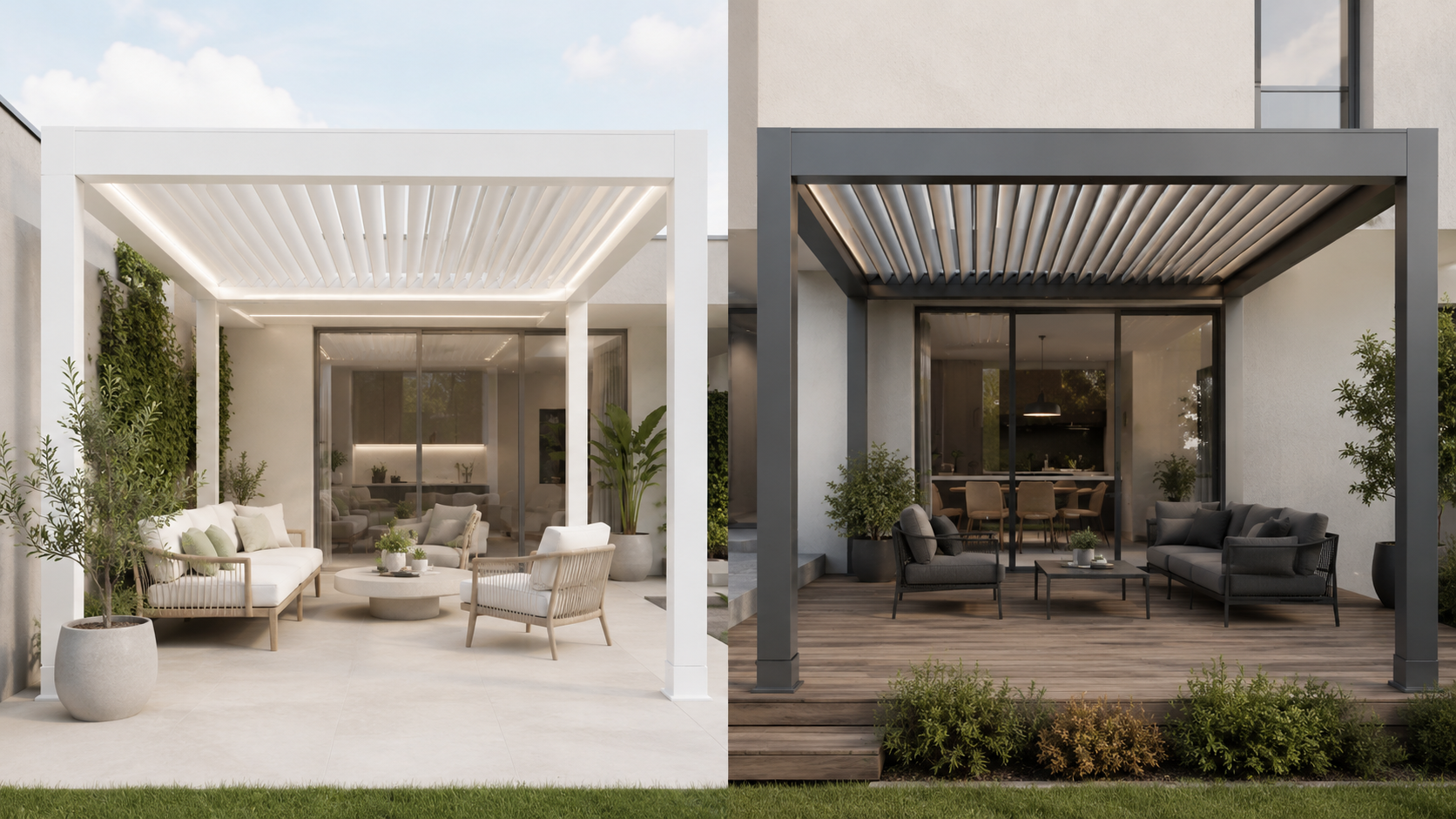
A white pergola can make an outdoor area feel brighter, softer, and more open. A grey pergola can make the same patio feel sharper, calmer, and more architectural. The tricky part is that both can look good in product photos. The real choice happens outside, beside the house wall, under the afternoon sun, with paving, plants, furniture, windows, and daily habits all in the picture.
Start with the House Exterior, Not the Colour Sample
The finish should not be chosen from a tiny colour chip on a desk. Outside, colour behaves differently. At 10 am, a white surface may look soft and clean. At 3 pm, beside pale tiles and a cream wall, the same surface may feel much brighter. Meanwhile, grey can look calm in strong sun, but it may feel heavy in a narrow courtyard with a close fence.
Therefore, the first test is not “which colour looks nicer?” A better question is: what does the house already say? A home with white render, beige stone, pale decking, or soft coastal planting usually accepts a lighter frame more easily. A home with charcoal windows, brick walls, dark gutters, or concrete paving often gives grey a stronger reason to exist.
Also, the pergola is seen from inside the home many times a day. The view from the kitchen window matters. The view through sliding doors matters. On an ordinary weekday evening, when the outdoor table is empty and the lights are off, the pergola still becomes part of the house. That is why the finish needs to feel settled even when no furniture styling is doing extra work.
A simple first check
Stand inside the main living area and look out toward the patio. If the outdoor structure should almost disappear into the brightness, white is usually the better starting point. If the structure should frame the space and make it feel more deliberate, grey deserves a closer look.
This is also where many colour decisions go wrong. The pergola is treated like a separate object, instead of a ceiling line attached to daily life. A finish that looks impressive on its own can feel awkward once it meets the door height, the roofline, the paving colour, and the garden beds. In other words, the right finish is the one that makes the whole outdoor area feel easier to understand.
 View P180 White or Grey Pergola
Where a White Pergola Works Best
A white finish works best when the outdoor area needs lightness. This is especially true for small patios, narrow courtyards, pale façades, coastal-style homes, and garden spaces where the structure should not dominate the view. The frame still has presence, but it does not press down visually.
For example, imagine a 3 m wide patio outside a dining room. The paving is light. The wall is cream. There is a timber table, two planters, and not much extra space. In that setting, a darker pergola may look smart, but it can also make the corner feel tighter. White keeps the overhead line lighter and lets the space breathe.
A white pergola also pairs well with soft garden colour. Pale green leaves, silver grasses, olive trees, white hydrangeas, lavender, and warm timber furniture all sit naturally beside a light frame. The result feels relaxed rather than empty, provided the space has enough texture.
White aluminium pergola for bright patios
A white aluminium pergola is useful when the outdoor area already has a clean, bright base. It can suit rendered walls, light cladding, pale stone, cream tiles, and outdoor furniture in beige, teak, or soft grey. The finish does not fight those materials. Instead, it extends the lighter mood of the home.
However, white should not be left too bare. A completely white patio can feel a little flat at midday, especially when the sun is high. Therefore, the space needs contrast from natural materials. Timber chairs, woven outdoor seats, large ceramic pots, or a darker outdoor rug can add just enough depth.
In daily use, white often feels calm in the morning. Coffee outside feels bright without being too formal. Around lunch, the adjustable louvres can help manage shade. Later, when the sun drops, warm lighting or candles can stop the white frame from feeling cold.
Best fit
Light façades, compact patios, coastal-style outdoor rooms, and soft garden planting.
Watch out for
Glare beside pale paving, glass fencing, or very reflective pool areas.
Style it with
Timber, woven textures, warm lighting, green planting, and soft neutral cushions.
The main point is simple. White should be chosen when the outdoor area needs air, brightness, and softness. It is not just a “safe” colour. Used well, it can make the pergola feel like a natural extension of the home rather than a separate outdoor structure.
 Compare White and Grey Finishes
Where Grey Works Better: Strong Lines, Brick, and Modern Contrast
Grey works better when the house already has stronger lines. Brick walls, charcoal window frames, dark gutters, concrete paving, black outdoor furniture, and stainless steel BBQ areas all give grey something to connect with. In those spaces, grey does not look heavy by accident. It looks planned.
The biggest strength of grey is definition. It frames an outdoor dining area more clearly. It can make a large patio feel like a proper outdoor room. It also gives the eye a darker reference point, which can be useful when the surrounding surfaces are very bright.
For example, a brick home with black-framed sliding doors may look unfinished with a very light overhead frame. The white frame can feel disconnected from the darker trim. Grey, by contrast, can echo the windows and make the pergola feel as if it was planned with the house.
White pergola vs grey: the mood changes quickly
When comparing white pergola vs grey, the mood difference is immediate. White opens the space. Grey defines it. White feels softer in a garden. Grey feels sharper beside architecture. White suits a quiet breakfast corner. Grey often suits an outdoor dining zone with a BBQ, lounge seating, and evening lighting.
Still, grey needs enough space. In a narrow side courtyard, a dark frame can visually lower the ceiling line. The patio may still function well, but the feeling can become boxed in. Therefore, grey is strongest when the outdoor area has enough width, depth, or open garden around it.
Grey also works well with accessories. Side blinds, lighting, glass doors, and darker outdoor furniture often look more integrated against a grey frame. This matters when the pergola is expected to support dinner, weekend cooking, or evening sitting, not only midday shade.
A clear rule of thumb
Choose grey when the pergola should frame the space. Choose white when the pergola should soften the space. If both ideas feel right, a grey frame with white louvres is worth checking before making the final decision.
In practical terms, grey is not only about hiding marks. It is about giving the patio a stronger edge. It can make furniture look more settled, lighting look warmer, and the outdoor area feel less temporary.
Cleaning, Glare, and Heat Perception
Colour does not only affect style. It affects how the space feels at the times it is actually used. On a bright summer afternoon, white can feel open and fresh, but it may also reflect more light beside pale paving or glass. Grey can feel calmer to the eye, but it can also make a small shaded patio feel visually heavier.
This is why glare should be judged on site. A pool fence, light concrete, cream exterior wall, or glossy outdoor tile can all bounce light upward. In that situation, a white frame may feel brighter than expected. Meanwhile, a grey frame may reduce the visual sharpness and give the eye somewhere to rest.
For Australian outdoor spaces, glare and reflected light should not be ignored. Cancer Council Australia explains that shade is an important part of sun protection, while reflected UV can still reach people around surfaces such as water, sand, concrete, and light-coloured outdoor materials. This makes the pergola finish, surrounding paving, pool area, and everyday shade habits worth considering together. Read Cancer Council Australia’s SunSmart guidance.
Cleaning is more straightforward. White shows dust, leaf marks, and rain streaks earlier. That can sound like a disadvantage, but it also encourages earlier care. Grey hides light dust better from a distance, although pollen, bird marks, and coastal residue still need to be removed.
A realistic care rhythm
A good routine does not need to feel like a weekend chore. After windy weather, check the louvre edges and visible frame surfaces. After rain, look at drainage paths and corners where leaves may gather. Once a month, a quick visual check is often enough to notice whether cleaning is needed.
Also, the pergola should not be treated like indoor furniture. It sits outside through sun, rain, insects, dust, and changing seasons. Gentle cleaning habits make more sense than hard scrubbing. A soft cloth, clean water, and regular small checks are usually more useful than waiting for dirt to build up.
For white finishes, visible edges near eye level deserve attention first. For grey finishes, the upper surfaces and drainage areas still need checking even when the frame looks clean from below. This small difference matters because hidden dirt can make the structure feel neglected later.
White finish care
Check visible edges after windy weeks, because dust and rain marks appear earlier on lighter surfaces.
Grey finish care
Do not rely on distance appearance. Check louvres, channels, and corners even when the frame looks tidy.
The better finish is the one that matches both the light and the cleaning rhythm. A patio used every day may benefit from a colour that feels comfortable in strong sun. A weekend-only space may simply need a finish that stays visually calm between uses.
 Explore Everpergo Pergolas
Real Patio Scenes: Which Finish Feels More Natural?
A colour choice becomes much easier when it is tied to a real outdoor scene. Product language can stay abstract, but a patio has ordinary moments: a chair pulled back at lunch, a child running through the doorway, a BBQ lid opened at 6 pm, or a wet table wiped after light rain.
For a small dining patio, white often feels easier. The space may only have room for a table, four chairs, and two planters. A lighter frame keeps the area from feeling crowded. Grey can still work, but it needs enough contrast from pale cushions, greenery, or open sky around it.
For a larger BBQ area, grey often feels more controlled. Stainless steel, darker cabinets, charcoal flooring, and outdoor lighting all make grey feel natural. The pergola becomes part of the cooking zone rather than a soft garden feature.
Pergola colour ideas by home style
On a coastal-style home, white usually fits the mood. It works with pale walls, timber decking, woven furniture, cream cushions, and breezy planting. The overall feeling is bright but not loud, especially when the furniture adds warmth.
On a modern brick home, grey often makes more sense. It picks up the shadow lines of window frames and roof trim. It also helps the pergola look more integrated with the house, especially when the patio has concrete or darker stone paving.
On a garden-heavy property, the decision depends on planting style. Soft, loose planting often pairs well with white. Structured planting, raised beds, clipped shrubs, and dark planters often support grey. As a result, the garden style can be a better guide than personal colour preference.
Quick matching guide
- Choose white with pale render, light decking, cream paving, and soft planting.
- Choose grey with brick walls, charcoal trims, concrete paving, and darker furniture.
- Choose grey with white louvres when the frame needs contrast but the roof should feel lighter.
- Add timber, stone, outdoor fabric, and plants to stop either finish from feeling too flat.
These are not strict design rules. They are practical filters. The finish should make the patio feel easier to live with at the main use time, whether that is morning coffee, Sunday lunch, or dinner after sunset.
Colour Options in the Everpergo Range
Everpergo focuses on all-aluminium louvred pergolas, including P120, P180, and P180 Pro. The range includes manual or motorised louvre options, freestanding or wall-mounted layouts, custom sizes, white and grey finishes, and a grey option with white louvres. That last combination is especially useful when the decision is not fully one direction.
Grey with white louvres can solve a common design problem. The grey frame gives the pergola definition against the house. Meanwhile, the lighter louvres reduce the visual weight overhead. This can work well when a home has dark window frames but a light patio floor.
Model choice should still come before colour excitement. A finish may look right, but the pergola also needs to suit the footprint, furniture layout, wall connection, drainage path, and daily use. A compact patio may not need the same configuration as a larger outdoor dining area.
Manual or motorised: colour still needs daily sense
Manual louvres can suit smaller patios where the roof is adjusted once or twice during the day. Motorised options make more sense when the outdoor area is used often, or when shade and airflow change through the morning, afternoon, and evening.
The finish should support that routine. A white pergola over a breakfast corner can feel light and relaxed. A grey pergola over a larger dining area with lighting can feel more structured in the evening. Grey with white louvres can sit between those two moods.
Installation planning should also stay clear. Everpergo does not directly provide installation services, but can recommend experienced installers and provide installation guides and technical support. This matters because a good finish still needs the structure positioned properly, with sensible post placement and clean alignment.
White
Best for visual lightness, compact patios, pale façades, and soft garden styling.
Grey
Best for modern lines, brick homes, darker trims, and larger outdoor rooms.
Grey with white louvres
Best when the frame needs definition but the overhead plane should stay lighter.
For a calm next step, compare finish, size, and configuration together on Everpergo Pergolas. The finish decision usually becomes clearer once the model, layout, and real use pattern are seen together.
 View P180 Finish Options
A Better Way to Choose: Use the Space Before Choosing the Finish
The finish decision should be made after the outdoor area has been “used” on paper. This sounds simple, but it catches many awkward choices early. Place the dining table on the patio plan. Allow room for chairs to slide back. Mark the walking line from the door to the BBQ. Notice where the posts may sit.
Then think about the uncomfortable hour. For many Australian patios, that may be 2 pm or 3 pm, when the sun is stronger and the paving starts to feel hot. For another home, the main issue may be evening use, when the space feels unfinished without lighting or side protection.
Once that moment is clear, colour becomes less abstract. If the space already feels bright and exposed, grey may calm it down. If the space feels tight and shaded, white may open it up. If both are partly true, the mixed finish may be the more comfortable answer.
The 15-minute finish test
- Look at the patio from inside the home, not only from the garden.
- Check the space at the hour it is used most often.
- Compare the finish against window frames, gutters, walls, paving, and furniture.
- Notice whether the pergola should blend in, soften the area, or frame it more clearly.
- Think about cleaning habits before choosing the lighter or darker finish.
This test is not fancy. It is just practical. It stops the colour choice from becoming a guess. More importantly, it keeps the decision connected to how the patio will feel on a normal day, not only how the pergola looks in a single product image.
In many homes, the answer becomes clear after this check. White usually wins when the patio needs space, softness, and brightness. Grey usually wins when the patio needs structure, contrast, and a more finished outdoor-room feeling.
Common Mistakes When Comparing White and Grey
The first mistake is choosing the finish before checking the façade. Colour should connect with the house. If the roofline, window frames, and paving all point in one direction, the pergola should not ignore them. A finish that fights the existing materials will always feel slightly off.
Another mistake is choosing grey only because it seems easier to keep clean. Grey can hide some dust from a distance, but it still needs care. Louvres, channels, post bases, and corners need checking after wind and rain. A darker finish does not remove maintenance; it only changes what is noticed first.
A third mistake is choosing white only because it feels fresh. White can be beautiful, but it needs the right surroundings. Beside very pale paving, glossy glass, or a bright pool area, it can increase the feeling of glare. In that case, grey or grey with white louvres may feel easier on the eye.
Finally, some decisions ignore furniture. That is a problem because furniture often decides whether the finish feels natural. White can look flat without texture. Grey can look hard without greenery or warm lighting. The pergola, furniture, and planting should be judged together.
A finish should not be asked to do everything. It should work with the house, then furniture and planting can complete the feeling. That is usually how the most natural outdoor spaces come together.
Final Advice: Choose the Finish That Solves the Space
The clearest answer is this: choose the finish that solves the outdoor space, not the one that wins in a product photo. A white pergola is usually better when the patio needs brightness, softness, and visual breathing room. Grey is usually better when the home needs structure, contrast, and a stronger outdoor-room feeling.
Also, the middle option should not be dismissed too quickly. Grey with white louvres can be useful when the house has darker trim, but the patio still needs a lighter overhead feel. It keeps the frame grounded while softening the roof plane.
Before making the final choice, review the house exterior at the main use time. Then compare finish, layout, size, and operation together. A colour decision made this way usually feels calmer because it is connected to real use, not just preference.
- For pale walls, small patios, and soft gardens, start with white and add texture through timber or woven furniture.
- For brick, charcoal trims, larger dining areas, and modern paving, start with grey and soften it with plants or warm lighting.
- For mixed homes, compare grey with white louvres before settling on a single-colour finish.
Next step
Compare White, Grey, and Grey With White Louvres
The finish becomes easier to judge when it is viewed beside size, layout, and louvre operation. The Everpergo pergola range includes all-aluminium louvred options for freestanding and wall-mounted outdoor spaces, with manual or motorised configurations available across selected models.
View Everpergo PergolasExtended Reading
These pages help narrow the decision after the colour direction feels clearer.
FAQ
Is a white pergola harder to keep clean than grey?
White usually shows dust, rain streaks, and leaf marks earlier than grey. However, that does not make it difficult to maintain. A regular light check after windy weather or rain usually keeps the finish looking fresh.
Does grey suit modern Australian homes better?
Grey often suits modern homes with brick walls, charcoal window frames, concrete paving, and darker outdoor furniture. Still, smaller or shaded patios may feel more open with white or with grey and white louvres.
What is the best finish for strong sun and glare?
The answer depends on surrounding materials. White can feel bright and open, while grey can feel calmer beside reflective paving, glass, or pool areas. The best check is to view the patio during its main use time.
Is grey with white louvres a good middle option?
Yes. Grey with white louvres can work well when the frame needs to connect with darker house details, but the overhead roof area should still feel lighter. It is useful for homes with mixed materials.
Does Everpergo provide installation services?
Everpergo does not directly provide installation services, but can recommend experienced installers and provide installation guides and technical support. Installation scope, electrical work, site preparation, and responsibility should be confirmed clearly before work begins.
Share:
Custom Pergola for Irregular Patios: When Standard Sizes Fail
Wall Mounted Pergola for Townhouses: Space-Saving Guide