

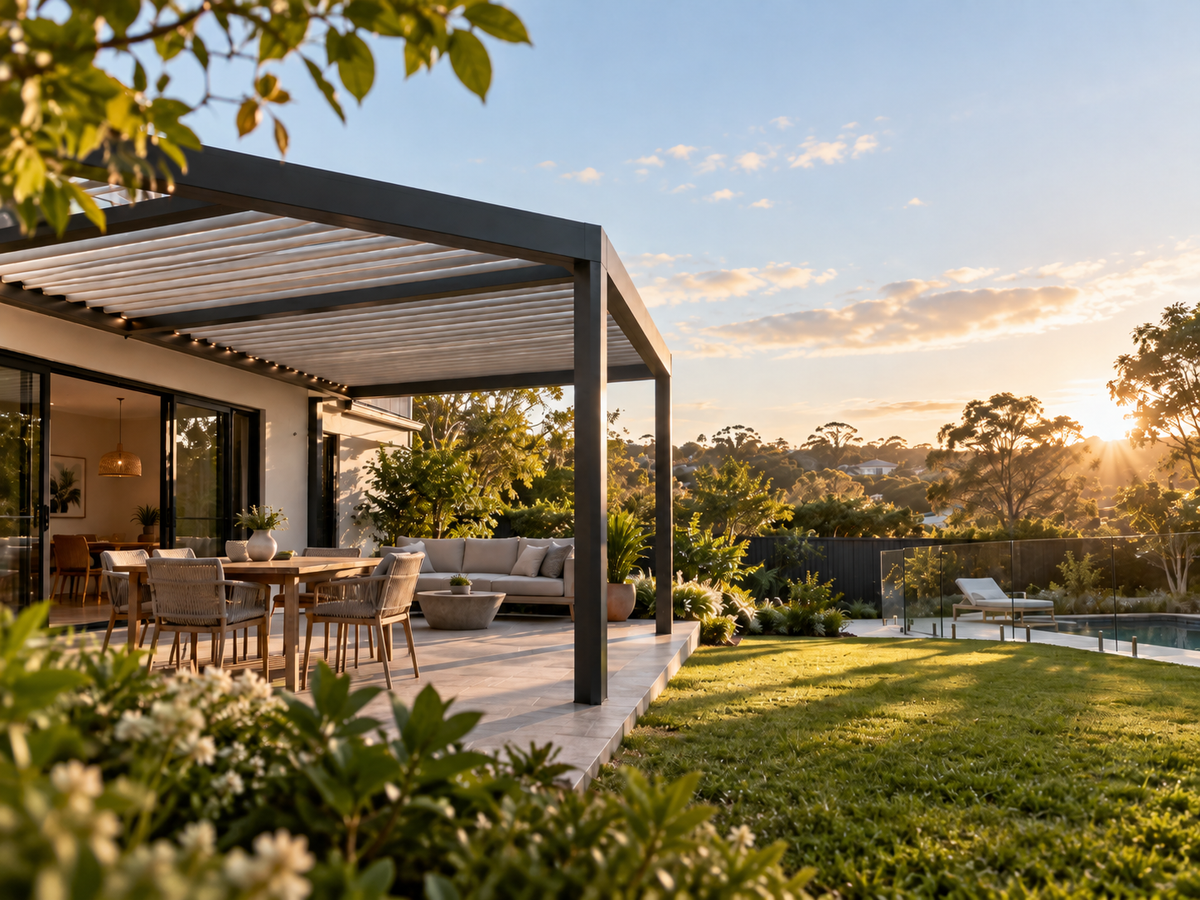
The practical pergola vs gazebo decision is less about which structure is generally “better” and more about how the backyard needs to work. A pergola usually keeps a stronger visual and physical connection with the house, patio, lawn and garden, while a gazebo more often behaves as a separate destination with a fixed roof overhead. Neither approach suits every home.
For an Australian backyard, start with three questions. Should the outdoor area feel connected to the rest of the property or deliberately separate? Does the roof need to stay the same throughout the day, or would changing the overhead condition be useful? And is the space mainly for everyday dining and lounging, or is it intended to become a distinct garden feature? Those questions usually reveal the right structural direction before product specifications enter the conversation.
Quick answer
A pergola usually makes more sense when the outdoor area should stay open to the surrounding backyard and work as an extension of everyday living. A gazebo usually makes more sense when the aim is to create a clearly defined, freestanding retreat with a permanent sense of overhead enclosure. If changing between a more open and more covered roof condition would improve daily use, a modern adjustable pergola deserves closer attention.

What separates a pergola from a gazebo?
The traditional definitions are useful, but they are not strict enough to make the decision by themselves. A pergola is generally an outdoor framework that defines an area through posts, beams, rafters or a roof system while keeping a relatively open relationship with the space around it. It may sit beside the house, cover an existing patio or deck, or stand independently farther into the yard.
A gazebo is generally understood as a more self-contained shelter with a complete fixed roof and a stronger sense that the area beneath it is its own destination. It commonly stands independently within a garden, although individual designs vary considerably.
The important exception is the roof. It is no longer useful to assume that every product described as a pergola must have a permanently open top. Contemporary pergola systems can use adjustable louvres, allowing the overhead plane to move between more open and more covered positions. A gazebo, meanwhile, does not need solid walls. Its sides can remain open while the fixed roof still gives the space a more pavilion-like character.
Think pergola
When the structure should frame an outdoor room without making the lawn, planting, sky and house feel disconnected from it.
Think gazebo
When arriving at the structure should feel like arriving at another place in the garden rather than simply moving into the next part of the patio.
This leads to a more useful distinction: an integrated outdoor zone versus a defined garden destination. A pergola often succeeds when it extends an existing entertaining or living area. A gazebo becomes especially logical when the separation itself adds value.
Scale can change either impression. A large freestanding pergola can become the strongest visual feature in a backyard, while a lightly proportioned gazebo with completely open sides may still feel airy. The structure type establishes the starting character; placement, proportions and daily use determine whether that character suits the site.
Australian approval check
Product terminology and planning or building classifications are not always identical. Requirements can vary by state or territory, local council, roof type, structure size, location and whether the structure is attached to another building. Local planning and building requirements should therefore be checked for the proposed site before a permanent structure is ordered or installed.
Openness, roof control and the feel of the space
Outdoor structures change more than what happens overhead. They change sightlines from inside the house, the route between rooms and the garden, and the perceived size of the yard. Those effects can be more noticeable than expected once posts, furniture and a roof plane occupy the space permanently.
Side openness affects the relationship with the backyard
A pergola commonly leaves its outer edges visually open. That allows a table, lounge or paved area to feel defined without appearing cut off from the garden around it. This quality is particularly useful where the outdoor area sits directly outside a kitchen or living room and people move between indoors, furniture and the lawn throughout the day.
On a smaller suburban block, preserving those longer sightlines can also stop the yard from feeling divided into several small compartments. The view from the house remains important: a structure that looks generous while standing beneath it may appear much heavier when viewed through the main living-room windows every day.
A gazebo creates a different relationship. Walking across a section of garden before entering the covered area reinforces the feeling that it is a destination. That can be useful for a reading corner, quiet conversation area or garden feature positioned away from the busiest part of the house.
Look from inside before deciding
Stand at the kitchen, dining or living-room window that faces the proposed location. If the most valuable view continues through the structure towards planting, lawn or a pool, openness deserves more weight. If the garden lacks a destination and would benefit from a strong endpoint, a more clearly defined structure may improve the composition instead.
Fixed cover and adjustable control support different routines
A gazebo normally establishes one consistent overhead condition. Its roof remains present on a bright morning, during lunch and after sunset. For a garden retreat intended to feel permanently sheltered, that consistency is part of the appeal.
A modern outdoor pergola can behave differently when adjustable louvres are part of the design. A more open roof position can maintain daylight and sky view when conditions are mild. Moving towards greater overhead cover can become useful when stronger sun or changing weather alters how the patio feels.
The value appears most clearly when the same area performs several jobs. A breakfast table used in the morning may benefit from different overhead conditions from the same table at lunchtime. A lounge that feels pleasant under deeper shade during the afternoon may feel unnecessarily closed after sunset.
For this comparison, the key question is simply whether one fixed overhead state or an adaptable state better matches the way the space is actually used. Detailed roofing-material or weather-performance comparisons are more useful after that structural direction is clear.

Which everyday uses favour each structure?
Style photographs tend to show outdoor structures at their calmest: chairs tucked neatly under a table, nobody moving between the kitchen and garden, and every surface clear. Real use is more revealing. The structure should make ordinary movements easier rather than forcing the household to work around it.
Outdoor dining
Follow the route between the kitchen, table and garden
A dining area directly outside the home often favours a pergola because dinner is rarely contained beneath one rectangle. Food moves from the kitchen, people pull chairs back, somebody crosses towards the barbecue and children may continue moving between the table and lawn.
An open-sided structure can allow those routes to pass naturally through the outdoor area. The dining zone still feels defined, but it remains part of the wider backyard rather than becoming a separate pavilion that has to be reached.
A gazebo becomes more convincing when the dining location is intentionally farther from the house. A table positioned at the end of a path or beside a garden feature can gain atmosphere from that separation. The trade-off is practical: meals, drinks and serving items have farther to travel, so the destination experience needs to justify that extra movement.

Casual lounging
Decide whether the lounge should extend the house or escape from it
A sofa or pair of outdoor chairs immediately outside the living room is usually used in short, informal ways as well as during planned entertaining. Someone may sit outside for ten minutes with coffee, take a phone call, watch children in the garden or join a conversation without deliberately “going somewhere”.
A pergola supports that type of continuity well. The structure can create enough definition to make the seating area feel intentional while leaving the transition between indoor and outdoor living relatively effortless.
A gazebo suits the opposite brief: the seating area is meant to feel removed from the busiest part of the home. In a larger garden, that separation can create a second outdoor atmosphere rather than asking the main patio to function as dining room, lounge and quiet retreat at the same time.
Garden focal point
Consider whether the structure or the landscape should lead visually
A gazebo often has the clearer advantage when the structure itself needs to organise the garden. Its complete roof and self-contained form are easy to read from a distance, which can give a long lawn, formal planting arrangement or garden path a natural destination.
A pergola can create a focal point too, but it often works more subtly. Instead of appearing as a small building placed in the garden, it can frame something already important: a deck, paved dining setting, pool edge, lounge or planted terrace.
The better choice depends on visual hierarchy. If the garden is already attractive and the structure should support it quietly, openness may be more appropriate. If the backyard feels undefined, a stronger destination can give the landscape the organisation it lacks.
Multi-use family area
Give everyday flexibility more weight than occasional events
A house-adjacent area may host breakfast in the morning, children moving outside after school, a shaded place to sit during the afternoon and dinner with friends at night. When the same footprint handles several routines, adaptability and circulation often matter more than creating one strongly defined retreat.
An open pergola can be easier to integrate into that pattern. A gazebo may still be the right answer where one dedicated activity deserves its own permanent place, but it is less likely to solve several connected house-and-garden movements at once.
A useful rule: design for the normal Saturday, not the biggest party of the year.
A structure used every week should respond to regular dining, lounging, garden access and the view from inside the house. Do not let one rare event dictate a layout that feels awkward for the other fifty weekends.
Compare the structure before comparing products
Product pages naturally draw attention towards colours, controls, frame details and individual configurations. Those details are useful only after the structural direction makes sense. Otherwise, it is easy to become attached to a particular product before deciding whether a pergola is the right type of outdoor space in the first place.
| Compare | Pergola | Gazebo |
|---|---|---|
| Openness | Commonly keeps a stronger visual and physical connection with surrounding patio, lawn or garden. | Usually feels more self-contained, even when its sides remain open. |
| Roof control | May use an open framework or an adjustable roof, depending on the design. | Usually establishes a fixed overhead condition. |
| Visual role | Often frames or extends an existing outdoor activity zone. | Often acts as a distinct architectural destination within the garden. |
| Typical use boundary | Useful when activities and movement flow between the house, patio and wider backyard. | Useful when one activity benefits from a clearly defined place of its own. |
These are tendencies rather than hard rules. Screens, furniture, planting, colour and scale can make a pergola feel more enclosed or a gazebo feel more open. The table is therefore most useful as a filter: which column sounds more like the experience the backyard is supposed to create?
Movement offers another useful check. If the likely dining table, lounge and normal route from the house cause people to move through several sides of the proposed outdoor area, the more open and integrated option usually deserves stronger consideration. If most activity naturally stays within one clearly defined zone, a self-contained structure becomes easier to justify.
Once the pergola direction is clearly the better fit, homeowners can compare the EVERPERGO aluminium pergola range in that context. This keeps the decision in the right order: choose the type of outdoor space first, then compare pergola solutions.
When an adjustable pergola is worth exploring
An adjustable pergola becomes relevant when the earlier comparison points clearly towards openness but the preferred overhead condition changes during normal use. Adjustable control should answer a real routine, not become an automatic upgrade added to every backyard.
Consider a patio outside the kitchen. On a mild morning, an open-feeling roof can allow more daylight into both the outdoor area and the adjoining room. Around lunch, stronger overhead shade may become more useful. Later in the evening, the need for shade disappears and a more open roof condition may suit the atmosphere better.
In that situation, one permanently fixed overhead condition asks the household to accept the same setting throughout every part of the day. Adjustable louvres provide another option because the roof can respond without moving the table or lounge to a different part of the yard.
Adjustable roof control has the clearest purpose when:
- the same outdoor zone is regularly used at different times of day;
- maintaining an open connection with the sky and garden matters when conditions allow;
- a permanently fixed roof would sometimes feel unnecessarily closed;
- changing the overhead state solves a repeated use problem rather than simply adding another feature.
The opposite case is equally useful for making the decision. If the structure is supposed to be a permanently covered retreat and the preferred condition rarely changes, adjustable roof control may contribute little to the actual experience. A gazebo or another fixed-cover structure may then remain the more coherent choice.
If an open-sided structure with adjustable louvres fits the intended routine, the next useful comparison is within the aluminium pergola range, where footprint, configuration and control requirements can be considered against the actual site.
For medium-to-large patios, outdoor dining areas and projects that need a versatile freestanding or wall-mounted configuration, the P180 pergola is one relevant model to compare once those site requirements are clear.
The decision in one sentence
Choose the structure by how the backyard should function first: favour integration and adaptable openness when those qualities matter, or favour a fixed, separate garden destination when that is the experience being created.
FAQs
Is a pergola always open-roofed?
No. Traditional pergolas are often associated with open beams or rafters, while contemporary products described as pergolas can use adjustable louvred roof systems and other forms of overhead cover. For a backyard decision, it is more useful to assess how open the structure feels and how the roof behaves than to rely on the product name alone. Local planning or building classifications should be checked separately before installation.
Does a gazebo always have enclosed sides?
No. A gazebo can remain open on several or all sides. Its complete fixed roof and stand-alone form are generally more useful distinctions than whether walls or screens are present.
Which structure feels more open in a backyard?
A pergola generally feels more open because it commonly keeps stronger sightlines and movement between the covered zone and the surrounding patio, lawn or garden. A gazebo can still have completely open sides, but its fixed roof and self-contained form usually create a clearer boundary around the space.
When does adjustable roof control matter?
It matters when the preferred overhead condition changes during normal use. A patio used for morning coffee, midday meals and evening entertaining may benefit from moving between more open and more covered roof positions. If the goal is consistently fixed shelter, that flexibility may not add much practical value.
Next step: before comparing models, it helps to have a realistic picture of the usable footprint, the likely dining or lounge position, normal walking routes and whether the structure will sit independently or beside the house. Those details make it much easier to judge whether an adjustable pergola fits the way the backyard is actually used.
Local approval requirements should also be checked before ordering. Once the site and daily-use priorities are clear, the EVERPERGO pergola range can be compared against those real requirements rather than appearance alone.
Share:
Single-Layer vs Double-Layer Louvre Pergola: What Changes in Everyday Use?
120mm vs 180mm Pergola Beams: What Frame Size Actually Means