

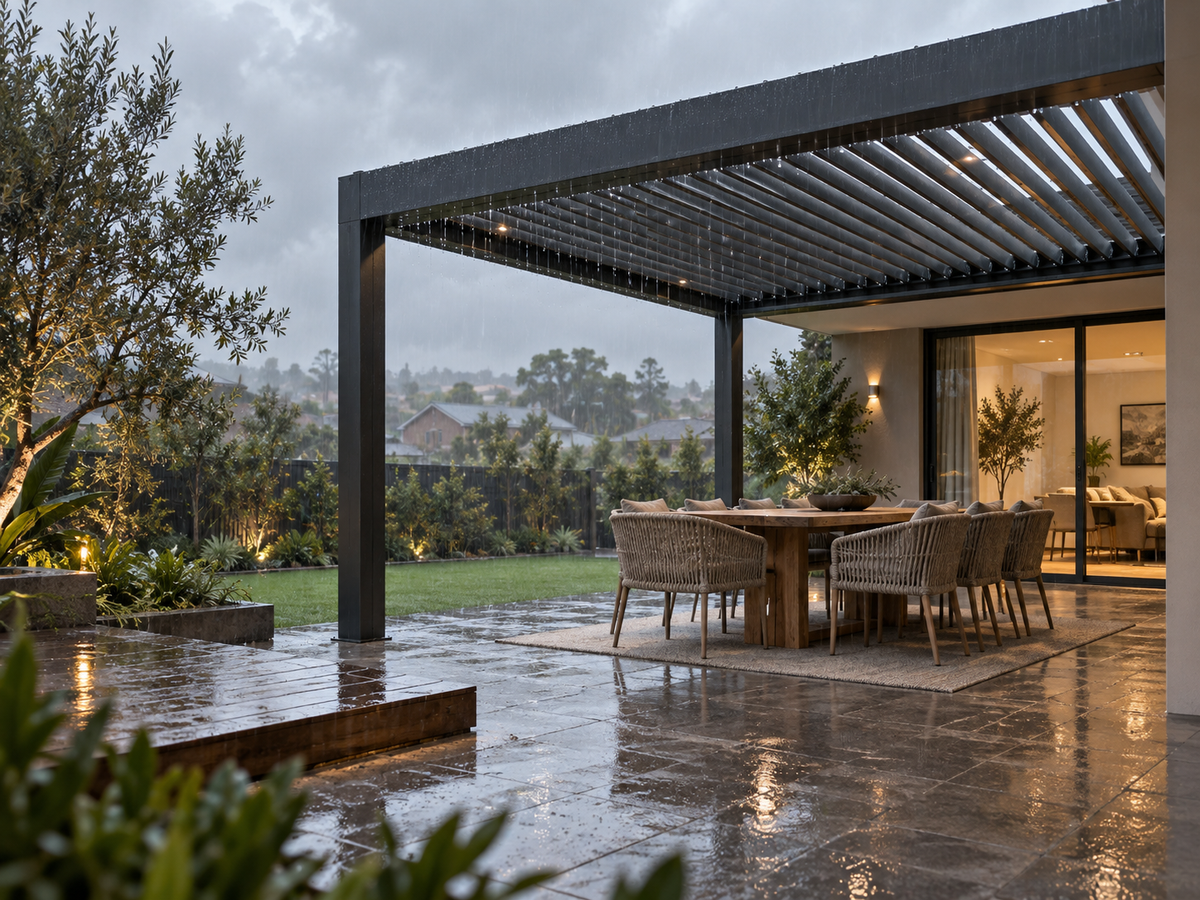
A louvre roof will not be silent in rain. What people hear underneath it changes with rainfall intensity, the pattern and size of the drops, where they are sitting, and the amount of background sound around the outdoor area. A light shower may register as a soft, regular patter; a sudden heavy burst can become much more noticeable.
That means louvre roof noise in rain is better judged as a comfort question than as a simple “quiet or loud” label. The useful test is whether the sound is likely to interrupt conversation, reading or evening relaxation in the particular setting where the pergola will be used.
Quick answer
Expect rain to be audible, and expect it to become more noticeable as rainfall gets heavier. For most homeowners, the practical question is not whether they can hear the roof, but whether the sound interferes with the way they want to use the outdoor area.
What should you expect to hear when rain hits a louvre roof?
For most homeowners, the important question is not whether the roof makes any sound. Rain striking an overhead surface is audible. The more useful question is how much attention that sound demands while the outdoor area is being used.
Imagine a typical Australian patio during a light afternoon shower. Two people are talking at a table, there is some traffic in the distance and doors to the house are open. The rain may become another layer of background sound, while conversation remains the main thing people notice.
Now change only the weather. A short, dense downpour arrives while the same people remain under the roof. More drops are striking the surface at the same time, so the roof sound becomes fuller and more continuous. For a while, the rain may become one of the dominant sounds in the patio.
Light shower
Individual drops are easier to distinguish, and the sound may stay behind normal conversation and outdoor activity.
Steady rain
Separate impacts begin to merge into a more continuous overhead sound that is harder to ignore in a quiet setting.
Heavy burst
Rain can temporarily dominate the outdoor soundscape until the intensity eases.
This is why describing a louvre roof pergola as simply “quiet in rain” does not tell a homeowner very much. Without comparable model-specific acoustic testing, there is no single sound level that can describe every roof, every site and every storm.
A casual barbecue area may tolerate a noticeable rain sound without affecting how the space is used. An outdoor lounge intended for reading, working or late-evening conversation may be judged more critically.
Why the same roof can sound different from one rain event to another
Even when the pergola itself has not changed, the experience underneath it can vary throughout the same storm. Rainfall changes, wind changes, and the sound around the patio changes with them.
Rainfall intensity and drop pattern
Fine drizzle, scattered large drops and dense rain do not strike a roof in the same way. At the beginning of a shower, a few larger drops can sound surprisingly distinct because there is space between each impact. Once the rain becomes steady, those individual sounds overlap and form a more continuous layer overhead.
Wind adds another variable. Rain may fall almost vertically for several minutes and then arrive at an angle as a gust passes, making one part of the roof sound more active than another.
This is worth remembering when watching a rain video. Thirty seconds recorded during a gentle shower does not show what the same roof will sound like during a heavy downpour. Equally, a dramatic clip from an intense burst should not be treated as representative of every rainy day.
Background sound changes what you notice
A patio beside a suburban road, pool equipment, children playing or an active kitchen already has a noticeable background sound level. During a light shower, rain may simply blend into that environment.
The same patio at 9 pm can feel quite different. Traffic has eased, indoor activity is quieter and conversation may be softer. Rain that barely attracted attention at lunchtime can seem much more present later in the evening.
A useful way to think about it
Instead of asking only “How loud is the roof?”, ask whether the rain sound is likely to interfere with what normally happens underneath it.
A shed, verandah, carport or enclosed room may give you a personal reference point for rain noise, but it cannot predict exactly how a different open-sided pergola will feel.
Does the roof construction make a difference?
Roof construction is part of the picture, but it is easy to draw more from a specification sheet than the information actually supports. Louvre design, roof size and the surrounding structure can all influence the finished outdoor environment, but a structural difference does not automatically tell you how much quieter or louder one model will sound in rain.
If you are comparing different roof designs, first understand what is physically different between them. Then, if rain noise matters to you, look for comparable rain footage, a display example or model-specific acoustic information rather than assuming that one construction must be quieter.
For more detail on the construction itself, see our single-layer vs double-layer louvre pergola guide .
Your outdoor setting matters too
A pergola with roof coverage is still part of an outdoor environment. Unlike a closed room, sound reaches you from the roof, the garden, the house façade, nearby paving and surrounding properties at the same time.
That makes where people actually sit one of the most useful things to consider when thinking about rain comfort.
Near the centre
The roof may feel more dominant overhead
From a central dining or lounge position, more of the roof surrounds the listener overhead. During steady rain, the sound may feel broader and more continuous.
Closer to an open edge
More of the garden joins the soundscape
Rain falling on planting, paving and other outdoor surfaces becomes easier to hear as well. The roof is still audible, but it is one part of a wider outdoor sound.
Hard surfaces can affect the way the space feels as well. A patio beside large areas of glazing, masonry or paving may sound different from a pergola opening directly towards lawn and planting. That does not give the roof itself an acoustic rating; it is simply part of the real environment in which the sound is heard.
Before buying, stand where the main dining table or lounge is likely to go. Is it close to the house wall? Is there a glass sliding door behind it? Are most sides open to the garden, or is the area enclosed by fencing and masonry?
If there will be more than one seating area, consider both. A dining table near the kitchen and a lounge further into the garden may not have the same rain-time experience.
What to check before choosing a louvre roof
If rain sound is important to your project, a real-world recording can be useful, especially when it shows the exact roof model and makes the rainfall conditions reasonably clear.
Look for enough context to understand what you are hearing: where the phone or camera is positioned, whether it is underneath the structure, and whether the rainfall is light, steady or heavy.
Even then, treat the recording as a reference rather than a precise prediction. Phone microphones automatically process sound, and playback volume changes the result again. A clip can show the general character of the rain sound, but it cannot reproduce exactly how another backyard will feel.

P180
Explore the P180 configuration and dimensions if this is one of the roof options you are considering.
View P180
P120
Review the P120 configuration in the same way, then consider rain comfort separately if it matters to your outdoor space.
View P120Comparing P120 and P180?
Do not assume one model is quieter simply because the structures look different. Unless comparable rain-noise testing is available, the more useful approach is to compare the roof configuration for your project and ask separately about any relevant rain footage or display experience.
Think about how you actually use the space
If the pergola is mainly for outdoor dining and entertaining, normal conversation may be the most useful reference point. If it will be used for reading, working or relaxing late in the evening, smaller changes in background sound may matter more.
Also consider how quiet the backyard normally is. Traffic, neighbouring activity, air-conditioning units, pool equipment and sounds from inside the home all form part of the background against which rain will be heard.
Finally, be realistic about wet-weather use. Some households mainly want shade and protection from an occasional shower. Others want to keep dining or relaxing outside while steady rain continues. Rain sound deserves more attention in the second situation.
FAQs about louvre roof noise in rain
Will a louvre roof be silent in heavy rain?
No. Rain hitting the roof will be audible, and a heavy downpour is likely to be considerably more noticeable than a light shower. Without verified model-specific acoustic testing, homeowners should not expect silence or rely on a fixed noise figure.
Can a phone recording show what the rain will sound like?
It can give you a useful reference for the character of the sound, but it cannot reproduce exactly how loud the roof will feel at your home. Microphone position, automatic audio processing, rainfall intensity and playback volume all affect what you hear.
Does hearing rain on the roof mean something is wrong?
No. Audible rain impact on an overhead surface does not by itself indicate a fault. A new, highly localised or unusual sound accompanied by abnormal movement or another clear change may deserve investigation, but normal rain sound alone is not enough to diagnose a problem.
Share:
100mm vs 140mm Pergola Posts: What Post Size Changes in Real Projects
Pergola Roof Condensation: Why Moisture Can Form and What Affects It