

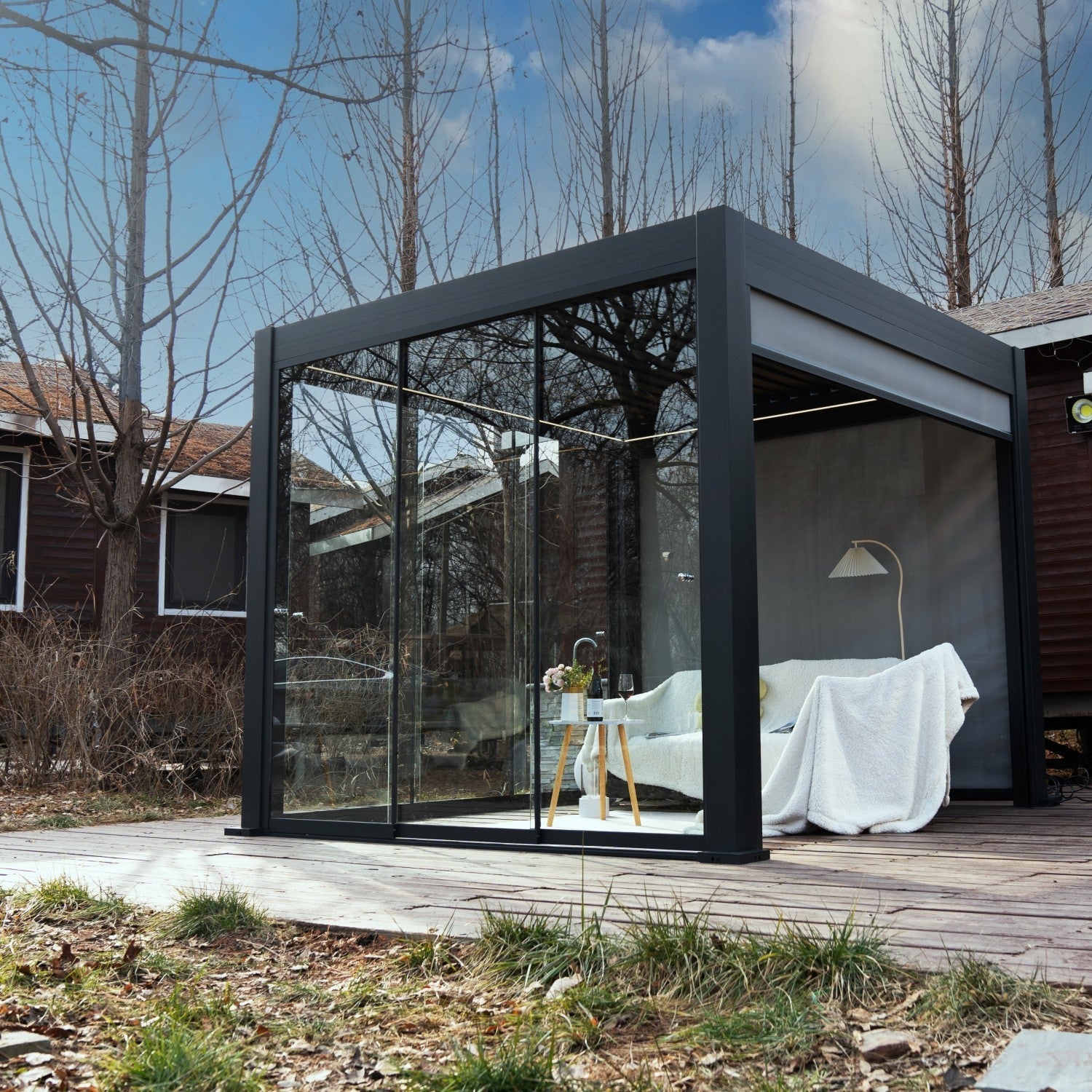
For most Australian homes, a manual louvre pergola is the practical choice when the roof will be adjusted only occasionally and keeping the initial cost down matters. An electric pergola is usually worth considering when the roof is larger, used frequently or difficult to reach.
Both options can provide adjustable shade, airflow and greater control over an outdoor area. The main difference is not the basic purpose of the roof, but how often you expect to move it, how convenient the controls need to be and whether you are comfortable adding powered components to the project.
Choose manual for a compact, easy-to-access pergola that will be adjusted occasionally and where simple operation is more important than remote control.
Choose electric when you expect to adjust the louvres regularly, want quicker control from the seating area or need a more practical way to operate a larger or elevated roof.
Manual vs Electric Louvre Pergolas at a Glance
| Decision point | Manual louvres | Electric louvres |
|---|---|---|
| How they operate | A hand crank mechanically changes the louvre angle. | A motor moves the louvres using the supplied control system, commonly operated by remote control. |
| Initial cost | Generally lower because there is no motorised control system. | Generally higher. The exact difference depends on the model, size, layout and whether lighting or other equipment is bundled with the configuration. |
| Best use pattern | Occasional adjustment during the day or between seasons. | Frequent adjustment for dining, entertaining, changing sun angles or regular daily use. |
| Convenience | Simple, but someone must stand beside the crank and operate it manually. | Faster to adjust without leaving the table, kitchen or seating area. |
| Power planning | The louvre mechanism does not need a fixed electrical supply. | Requires a suitable power and control plan. Cable routes and any fixed electrical work should be confirmed before installation. |
| Maintenance | Crank, gearbox, linkages, louvres, gutters and drainage still require inspection and cleaning. | Requires the same roof and drainage care, plus attention to the motor, controls, remote and electrical connections. |
| Possible faults | Has fewer powered components, although mechanical parts can still wear, loosen or become obstructed. | Motor, receiver, remote or power faults may require troubleshooting or replacement by a qualified service provider. |
| Large or elevated roofs | Can become less convenient when the roof is large, divided into multiple sections or positioned away from normal access. | Often better suited to larger or harder-to-reach installations, subject to the selected system and configuration. |
When a Manual Louvre Pergola Makes More Sense
A manual pergola keeps the control method straightforward. A hand crank turns the mechanism and moves the louvres without relying on a motor, remote or fixed power connection for roof operation.
This is often enough for a smaller backyard, courtyard or patio where the louvres may be opened in the morning, adjusted once as the sun moves and closed again later. When the crank is easy to reach, the extra time required to operate it may have little effect on everyday use.
Why homeowners choose manual operation
- Lower upfront cost: You pay for the adjustable roof without adding a motorised control system.
- Straightforward operation: There is no remote to store, pair or replace.
- No louvre motor power requirement: This can simplify planning where electricity is not already available near the pergola.
- Fewer powered components: There are fewer electrical parts that may eventually require diagnosis or replacement.
Manual does not mean maintenance-free. The crank assembly, moving connections and louvre mechanism should still move smoothly, while leaves and dirt need to be cleared from the roof channels and drainage paths. Forcing a crank when the roof is obstructed may damage the mechanism.
When an Electric Louvre Pergola Is Worth the Upgrade
Electric operation removes the need to stand beside the pergola and turn a crank each time the light or weather changes. This difference can feel minor during a showroom demonstration, but it becomes more useful when the outdoor area is used several times a week.
Remote operation is particularly practical when the roof covers a large dining setting, lounge area or commercial seating zone. It may also improve accessibility for people who would find repeated manual cranking uncomfortable.
Why homeowners choose electric operation
- Quicker adjustments: Change the louvre angle without interrupting a meal or moving away from guests.
- Better for regular use: Convenience matters more when the roof is opened and closed several times a day.
- Suitable for larger layouts: A motor reduces the physical effort involved in controlling a wider roof or compatible multi-section arrangement.
- More practical for elevated locations: Remote control can be useful where the pergola mechanism would otherwise be inconvenient to access.
Some motorised pergola systems may support additional controls or weather sensors, but these should not be assumed to be standard. Confirm exactly what is included, what is compatible with the selected model and how the system should be operated during severe weather.
Manual is likely to suit you when:
- The pergola is compact and the crank will remain easy to reach.
- You expect to adjust the roof only occasionally.
- Keeping the product cost lower is a priority.
- You prefer a simple mechanical control method.
- Providing power near the pergola would complicate the project.
Electric is likely to suit you when:
- The outdoor area is used frequently for meals or entertaining.
- You want to adjust the roof without leaving the seating area.
- The pergola is large, elevated or difficult to access.
- Manual cranking may be inconvenient for household members.
- You value everyday convenience enough to accept the additional cost and powered components.
Power, Maintenance and Warranty Questions to Check
The cost of an electric pergola is not limited to the motor itself. Before ordering, establish how power will reach the structure, where controls will be positioned and whether electrical preparation is included in the product or installation quote.
Any fixed electrical connection should be assessed and completed by an appropriately licensed electrician where required. The final arrangement may depend on the pergola model, distance from the existing supply, cable route, lighting choices and local site conditions.
Do not assume electric louvres have a manual backup. Ask what happens during a power interruption, whether the roof can be repositioned without power and who should service the motor or control unit if a fault occurs.
Everpergo’s current website states a 10-year warranty for the main aluminium structure and a 2-year warranty for motorised systems. Before purchase, confirm the written warranty supplied with your exact configuration, including covered components, maintenance expectations, installation conditions and exclusions.
Manual buyers should also check warranty coverage. The absence of a motor does not mean the crank, gearbox, connecting hardware and other moving parts are automatically covered for the same period as the main aluminium structure.
Does Electric Operation Provide Better Weather Protection?
Electric operation can make it faster and easier to change the louvre position when conditions change. It does not, by itself, make the pergola more weather-resistant than an equivalent manual roof.
Rain management depends on the louvre design, alignment, seals, gutters, drainage routes, installation quality and ongoing cleaning. Closed louvres can help direct rainwater into the drainage system, but no outdoor pergola should be described as completely waterproof in every condition. Wind-driven rain and unusually severe weather may still allow water into the covered area.
Strong wind also requires more than pressing a remote button. Operate the pergola according to the manufacturer’s instructions and ensure the selected structure, foundations and fixings are suitable for the site. Wind loads and installation requirements should be confirmed by the relevant engineer, qualified installer or local authority where necessary.
Six Questions That Usually Settle the Decision
-
How often will you move the louvres?
If the answer is only a few times each week, manual operation may be enough. Daily or repeated adjustment makes electric control more valuable. -
Can every household member operate a crank comfortably?
Consider the height, position and physical effort involved rather than judging the crank only when the pergola is new. -
How large is the roof?
A compact single section is easier to operate manually than a wide roof or a layout with several controllable areas. -
Is suitable power already available?
If not, include electrical planning and any licensed trade work when comparing the finished project cost. -
What exactly is included in each quote?
Compare the same size, model, layout, lighting and installation scope. A motorised package may include equipment that is not part of the manual configuration. -
Which inconvenience would bother you more?
Choose between paying more now for convenience or accepting manual operation each time the roof needs adjustment.
Quality Matters More Than the Control Method
Manual and electric controls change how you interact with the roof, but neither option compensates for an unsuitable structure or poor installation. The pergola still needs the correct footprint, stable support, effective drainage and appropriate fixing for the property.
When comparing products, look beyond the remote or crank. Check the aluminium structure, louvre movement, gutters, seals, post and beam proportions, spare-part availability and after-sales support. Deck suitability, wall connections, footings, drainage, electrical work, wind requirements and council obligations must be assessed for the individual site.
The right option is the one that fits the way the outdoor area will actually be used. A manual roof can be an excellent long-term choice for a compact patio, while electric control can remove a repeated inconvenience from a larger or frequently used entertaining area.
Still Deciding Between Manual and Electric?
Review the available Everpergo pergola configurations, then send your approximate measurements, site photos and preferred control method for more specific guidance.
Discuss Your Pergola Options
Share:
The Secret of Louvre Angle Adjustment: How to Achieve Year-Round Outdoor Comfort
No Rust, No Rot: Why Aluminum Is the Ultimate Material for Outdoor Pergola